

Reciprocal links are treated as inherently worse than one-way links, and the reasoning behind that belief is mostly wrong. Here is what actually differs between them, when the difference matters, and how to measure your own ratio.
Ask most SEOs whether reciprocal links are worse than one-way links and you will get an immediate yes. Ask why, and the answer usually gets vague. The common explanations — that the value cancels out, that Google discounts them automatically, that they carry a fixed penalty — are either wrong or oversimplified to the point of being useless. The real difference is narrower than the reputation suggests and it sits somewhere most people are not looking.
The definitions, and the third category nobody mentions
A one-way link points from site A to site B with nothing coming back. Site B gave nothing in return.
A reciprocal link is a mutual pair: A links to B and B links to A.
The third category is the one that gets left out of every comparison, and it is the interesting one. Non-reciprocal exchange — A links to B, B links to C, C links to A, or the marketplace version where you post criteria and any qualifying publisher takes the offer. Links were coordinated, but no mutual pair exists. That third category is why “reciprocal versus one-way” is a false binary. The meaningful axis is not whether a link came back. It is whether the resulting link graph shows a computable pattern.
What actually differs between them
Four real differences, in descending order of how much they matter.
1. Detectability. This is the entire substance of the reciprocal-links problem. A mutual pair is symmetrical, and symmetry is cheap to compute across a link graph. If you hold thirty mutual pairs, that is thirty instances of a pattern that occurs at a much lower rate in organic profiles. Nothing about the individual link is worse. The set is legible.
2. Outbound cost. A reciprocal link costs you an outbound slot and the equity that passes through it. A one-way link costs you nothing. At small volumes this is negligible; at a hundred placements it is a real change to your own outbound profile — the kind of portfolio-level accounting the advanced link exchange strategy guide covers in detail.
3. Correlation with intent. Reciprocal links are more likely to have been arranged, and arranged links are more likely to fail the “would this exist without SEO” test. This is a correlation, not a property. Plenty of mutual links are entirely organic.
4. Policy exposure. Google’s spam policies name excessive link exchanges specifically, with the phrasing “link to me and I’ll link to you”. One-way links are not named. That said, the operative word is “excessive” — the policy targets coordination at volume rather than the existence of mutual links, which is covered in more depth in the link exchange guide.
Three things people believe that are not true
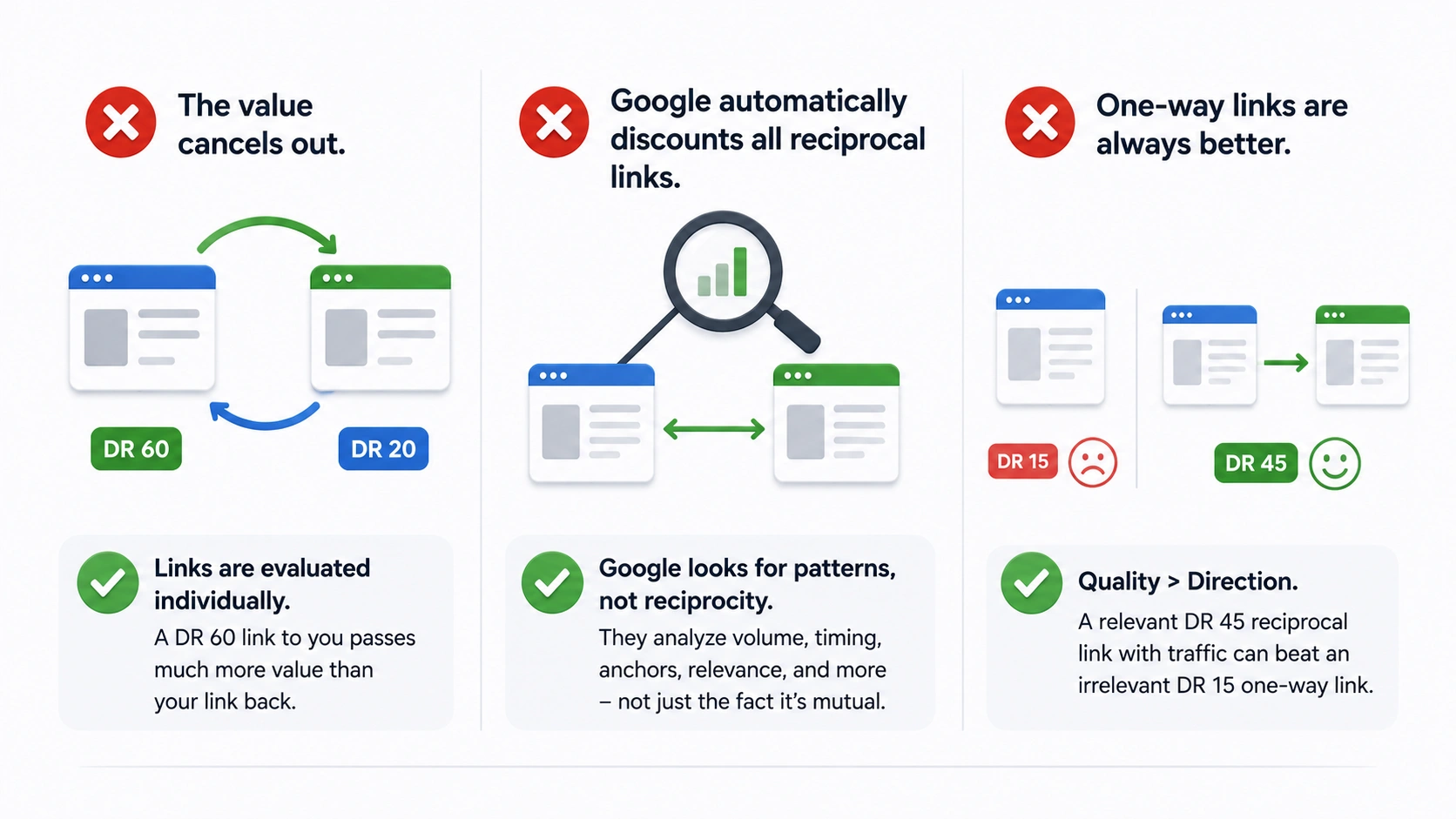
“The value cancels out.” The most common explanation and the least accurate. PageRank does not net off between two pages — the flow is directional and each link is evaluated on its own. A DR 60 site linking to your DR 20 site passes considerably more than your link back passes to them. The exchange is asymmetric in your favour, which is precisely why the arrangement appeals to smaller sites.
“Google automatically discounts all reciprocal links.” If this were true, natural mutual linking between related sites would be systematically devalued, which would degrade the quality of the link graph rather than improve it. What the systems look for are patterns that indicate coordination — volume, timing, anchor uniformity, topical incoherence — not the mere fact of reciprocity.
“One-way links are always better.” A one-way link from an irrelevant DR 15 site with no traffic is worse than a reciprocal link from a relevant DR 45 site with a real audience. Directionality is one variable among six or seven, and it is not the heaviest one. Relevance, authority, placement, and actual traffic all outrank it.
A worked comparison
Take two links available to the same site — a DR 28 project management blog.
Option A. One-way link. DR 22 general business directory, roughly 400 monthly visitors, link sits in a category listing alongside 180 other companies, anchor is the company name.
Option B. Reciprocal link. DR 44 productivity software blog, roughly 9,000 monthly visitors, link sits mid-article inside a post on team workflows, anchor is a descriptive phrase, and you place a link back to their comparison page from one of your guides. Option A is theoretically cleaner. Option B is worth several times more. The directory link sits on a page with no editorial weight, competing with 180 other outbound links, from a site with negligible traffic. It passes very little and sends nobody. The reciprocal link comes from a relevant site with a real audience, sits in context, and will send actual referral visitors — which is the one effect you can measure directly rather than infer. The cost of Option B is one outbound slot and the fact that it forms a mutual pair. If that pair is one of eight over a year, spread across different niches with varied anchors, the detectability cost is close to zero.
The comparison flips if Option B is your thirty-fifth mutual pair in four months, all pointing at the same commercial page. Then the set is the problem and the individual quality of the link is irrelevant.
What a healthy ratio looks like
Google publishes no threshold and anyone quoting one as official is inventing it. A working heuristic circulated in the industry puts reciprocal links above roughly 20–30% of a profile as the point where the shape starts to look coordinated. Treat that as a sanity check rather than a rule. Two adjustments matter more than the raw number.
Niche size. In a vertical with forty relevant sites, mutual linking is close to unavoidable — everyone references everyone because there is nobody else to reference. Natural reciprocity runs higher in small niches and this is normal.
Profile age and size. A site with 900 referring domains absorbs twenty mutual pairs without the ratio moving. A site with 40 referring domains does not. The same twenty links produce a 2% reciprocal share in the first case and 50% in the second.
How to measure your own ratio
Twenty minutes, works with Ahrefs, Semrush, Moz, or Ahrefs Webmaster Tools on the free tier.
- Export referring domains. Domains, not backlinks — fifty links from one site is one relationship, and counting links inflates your denominator
- Export outbound linked domains. In Ahrefs: Outgoing Links, then Linked Domains. Most people have never opened this report
- Intersect the lists. A match formula in a spreadsheet is sufficient. The overlap is your reciprocal set
- Divide. Reciprocal domains over total referring domains
- Sort the reciprocal set by first-seen date. This matters more than the ratio. A flat, irregular spread over years is unremarkable. Clusters are the signal
- Group inbound anchors by target URL. If one phrase dominates a commercial page, that is louder than any reciprocity finding
Run this before deciding you have a problem. Most sites that worry about reciprocal links have a single-digit percentage and a genuine issue somewhere else entirely.

Edge cases
Partner and integration links. A software company linking to its integration partners, who link back, is documentation rather than a scheme. The relationships exist independently of search. This holds at reasonably high volume because the structure is visible and legitimate.
Supplier and client links. Same logic. Your supplier lists you as a stockist, you list them as a supplier. This is how commerce works and nobody is confused by it.
Inherited profiles. If you acquired a domain carrying a reciprocal-heavy profile, dilute with new one-way links rather than stripping the old ones out. Growing the denominator is safer and less disruptive than shrinking the numerator, and the how to get backlinks guide ranks the tactics that produce links with nothing owed back.
Nofollow on one side. Using nofollow on your outbound link to make an exchange “safer” does not work as compliance and does work as a way to annoy the other party, who will notice.
Sitewide reciprocal links. A mutual link in a footer or sidebar across every page is worse than a single in-content pair, not better. Volume of placements from one relationship adds nothing and the template placement is itself a pattern.
So are reciprocal links safe?
Yes. Reciprocal links are safe, they are normal, and they are not prohibited by anything. They occur across the web constantly — suppliers reference each other, a tool and a tutorial site link both ways, a podcast and a guest link to each other’s pages, two adjacent publications cite each other’s research. A policy banning mutual linking would flag a large share of the legitimate web, and no such policy exists. Google’s own documentation does not say reciprocal links are against the rules, because they are not. What it names is excessive link exchanges, and the word is doing the work. The target is coordination at volume for the purpose of moving rankings — not the presence of mutual links in a profile.
The practical test: could you explain why a specific link exists without mentioning SEO? A supplier listing a stockist passes. A guide referencing a tool it recommends passes. Thirty pairs acquired in six weeks, all pointing at one commercial page, all with the same anchor, does not — and that is a volume and pattern problem rather than a reciprocity one. One more thing worth knowing, because most people imagine the wrong risk entirely. Even when this is done badly, the common outcome is not a penalty. It is algorithmic devaluation — the links stop counting, nothing appears in Search Console, and rankings do not drop so much as fail to rise. So the downside is wasted effort, not damage. You are not avoiding a punishment. You are avoiding six months spent building links that do nothing — which is a much smaller thing to be afraid of than the reputation suggests.
The version that avoids the pattern entirely
Back to that third category, because it is the practical answer to everything above. If links are matched on criteria rather than agreed bilaterally, mutual pairs do not form by default. You post what you want — target page, niche, minimum DR — and any qualifying publisher takes it. The publisher who links to you is not the one you link to, so the symmetry that makes bilateral swapping computable never exists. That removes the detectability problem, which is the substantive item on the list of four differences. It does not remove the others: you still spend an outbound slot, and timing, anchors, and placement can still converge into patterns of their own. Breaking one pattern while preserving three moves the footprint rather than removing it. Linkexchange works this way, from inside your WordPress dashboard. Requests are posted rather than negotiated, settlement runs on credits, referral traffic is attributed per link so you can see which partners send real people, and placements are monitored — which matters here because a link that came down is not in your ratio either, and most sites are measuring a number that has quietly drifted. The internal linking tools are included free, and they are the better first move if your reciprocal ratio is high because your profile is small. Analysis costs nothing — orphan pages, weak pages, authority flow, and the connections your site is missing. Growing the denominator is the fix for a skewed ratio, and the cheapest way to start is with the authority you already have.
The practical conclusion
Stop optimising for the reciprocal-versus-one-way distinction. It is the wrong axis. Optimise for two things instead.
Per link: relevance, real traffic, in-content placement, and a clean outbound profile on the linking site.
Across the set: irregular timing, varied anchors, varied placement positions, and a partner pool that does not converge. A profile of thirty relevant links from real sites, acquired unevenly over a year with mixed anchors, is defensible whether ten of them are reciprocal or none are. A profile of thirty links acquired in six weeks with three anchor variants is a problem whether they are reciprocal or not. A profile of thirty relevant links from real sites, acquired unevenly over a year with mixed anchors, is defensible whether ten of them are reciprocal or none are.