

Guest posting costs days of work per link and produces a strong one. Backlink exchange costs an outbound slot and produces links faster. Here is what each one actually costs, and which one belongs in which slot of your strategy.
These two get compared constantly and the comparison is usually framed wrong — as though you should pick one. They occupy different positions on the cost curve and solve different problems. The useful question is not which is better but which is doing which job in your mix, and what each actually costs once you count the attempts that fail.
What each one actually involves
Guest posting. You identify a target publication, pitch a topic, wait for a response, write 1,200 to 2,000 words to their standard, submit, respond to edits, and wait for publication. Somewhere in that article sits a link to your site, usually one, sometimes in an author bio rather than the body.
Backlink exchange. You identify a relevant site, agree terms, place a link to them in your existing content, and they place a link to you in theirs. No new article is written on either side. Or, on a marketplace, you post your criteria — target page, niche, DR floor — and any qualifying publisher takes the offer. The structural difference is that guest posting requires you to produce an asset for someone else, and exchange requires you to spend an asset you already own. That single distinction drives most of what follows.
What each one actually costs
Both are usually costed wrong, because people count the successes and forget the attempts.
Guest posting, worked through. Assume a 15% pitch acceptance rate, which is optimistic for a site without an established name. To land one placement you send roughly seven pitches. Research and personalization at 20 minutes each is about 2.3 hours. Follow-ups add another 30 minutes. The accepted piece takes 4 to 6 hours to write properly, plus an hour on edits and coordination.
Total: roughly 8 hours per link. At a modest internal rate of $50/hour that is $400 in time. If you outsource the writing instead, published rates for a competent 1,500-word piece run $150 to $400, plus your own pitching time. If you pay for placement rather than earning it, 2026 pricing studies put transacted guest post costs around $164 on the low end to $459 average, with quality-band placements on DR 50+ sites running $600 to $1,200. The how much do backlinks cost breakdown covers why those published figures disagree so widely.
Exchange, worked through. Partner identification and vetting: 15 to 30 minutes if you are doing it manually, near zero if matching is handled. Agreeing terms: 10 minutes. Placing your outbound link inside existing content: 15 to 20 minutes, since you are editing rather than writing. Confirming their side: 5 minutes.
Total: roughly 1 to 1.5 hours per link. Around $60 in time at the same rate. But that is not the full cost, and any comparison that stops there is dishonest. Exchange also costs you an outbound link slot on a page you own, plus the equity that passes through it. That is a real asset with a market value — price your own slot and you will find it is not trivial.
What you get for the money
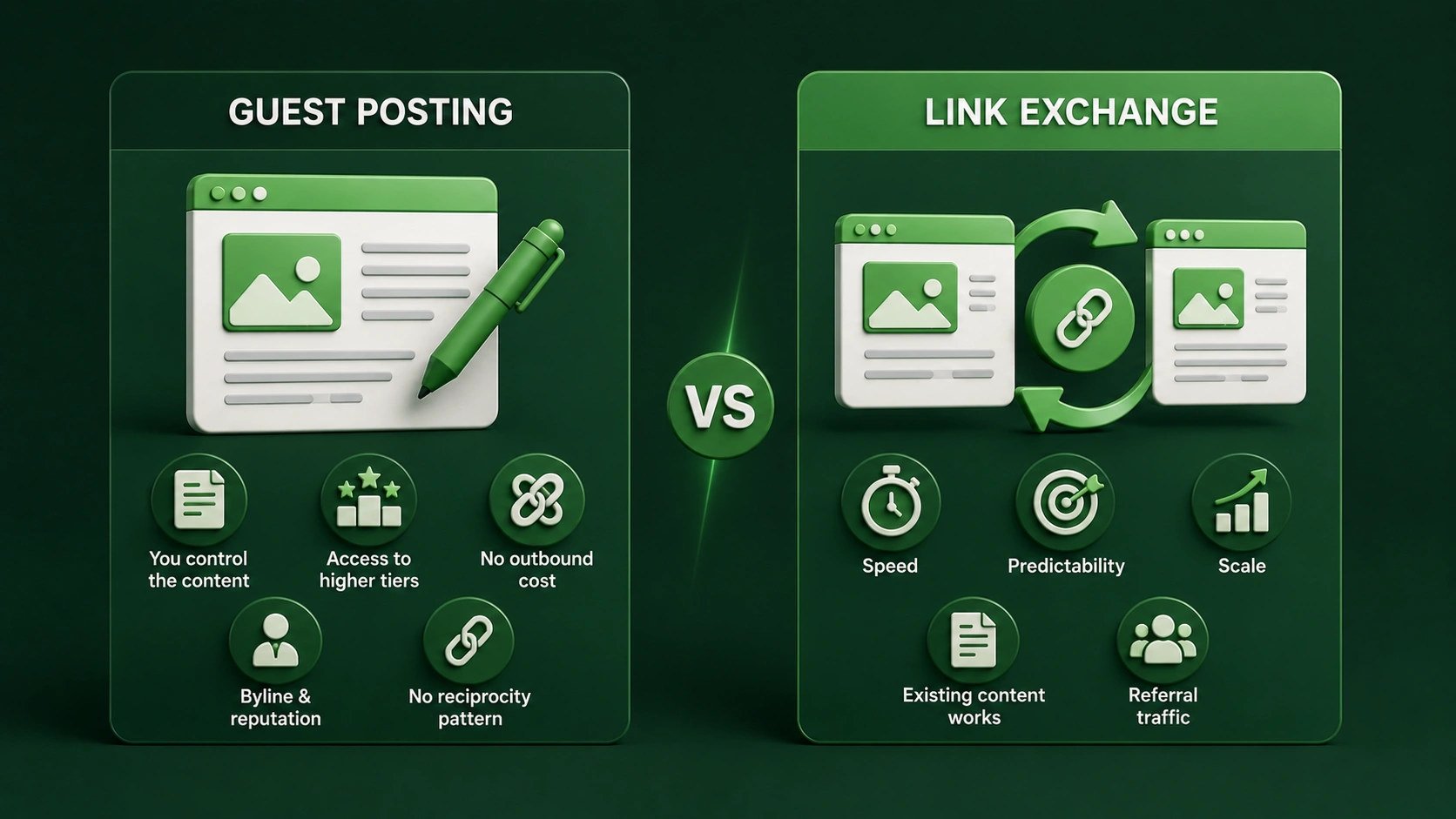
The cost gap is roughly 5x in guest posting’s disfavour. The quality gap runs the other way, and it is narrower than that. Guest posting advantages:
- You control the content. The article is built around your link, so the surrounding context is exactly as relevant as you make it
- Access to higher tiers. Some publications will accept a contributed article from a site they would never do a link swap with. This is the strongest argument for guest posting and it is decisive for a handful of targets
- No outbound cost. You give nothing from your own site
- Byline and reputation. Appearing as a contributor on a respected publication has value beyond the link — it is an E-E-A-T signal and occasionally a business development channel
- No reciprocity pattern. The link is one-way
Exchange advantages:
- Speed. Days rather than weeks. The publication delay alone on guest posting is often three to six weeks after acceptance
- Predictability. Terms agreed means link placed. Guest post pitches fail after you have done the work of researching them
- Scale. Effort per link stays roughly flat, which is the property guest posting fundamentally lacks
- Existing content works. Your side of the trade uses pages you already have, so nothing new gets written
- Referral traffic. A link inside an established, already-ranking article on a relevant site often sends more visitors than a new guest post that nobody has found yet
That last point is underrated. A guest post is a new page starting from zero — it has no rankings, no traffic, and no accumulated links. A well-placed exchange link can sit in an article that has been ranking for two years.
The risks are not symmetrical
Guest posting risk is mostly about the target. Google’s spam policies name large-scale article campaigns where the primary purpose is link acquisition rather than audience value. A guest post on a legitimate publication with editorial standards is not that. A guest post on a site that publishes forty contributed articles a month with no review is. The tell is whether anyone would have commissioned the piece if it carried no link.
Exchange risk is about the pattern. The policies name excessive link exchanges, with the operative word being excessive — coordinated reciprocal linking at volume, rather than the existence of mutual links. Relevance, moderate pace, in-content placement, and varied anchors are what keep it on the right side. The backlink exchange guide covers the four rules in full. Neither risk is eliminated by preferring the other tactic. They are just different failure modes, and the guest posting one is easier to avoid because it requires evaluating one site rather than managing a growing set.
Which slot each one fills
The framing that actually helps: these are not competitors, they are different line items.
Guest posting is a targeted instrument. Use it for two or three publications a year that you specifically want to appear on — the ones where the byline matters, or where the authority is high enough that no exchange would ever be offered. Treating it as a volume tactic is what produces contributed content on sites nobody reads.
Exchange is an engine. It fills the slot in your strategy that runs every week without heroics, because effort does not scale linearly with output. Every mix needs one tactic in that slot, and the candidates are limited. A realistic quarter for a small site: two guest posts on genuinely wanted targets, a steady exchange programme running throughout, and one substantial asset — original data, a tool, a definitive reference — building in the background. The how to get backlinks guide ranks all eleven tactics on this basis.
What makes the engine slot work
The claim that exchange scales where guest posting does not rests on one thing: the mechanical parts not being yours to do. Done by hand, exchange is finding relevant partners, checking DR and outbound profiles one at a time, agreeing terms, confirming both sides delivered, and then monitoring indefinitely for removals. That is still less work than guest posting, and it is enough work that most people stop doing it around week five. Linkexchange runs that cycle from inside your WordPress dashboard. You post what you want — target page, niche, DR floor — and any qualifying publisher takes the offer, which also means the resulting links are not mutual pairs by default. Settlement runs on credits, referral traffic is attributed per link so you can see which partners send actual people, and placements are monitored so a removed link surfaces immediately rather than at an audit next year. That last part matters for the cost comparison above. A guest post you wrote and a link you exchanged are both worth nothing once they come down, and only one of those is being checked on most sites. The internal linking tools are included free, and they are worth running before either tactic. Analysis costs nothing — orphan pages, weak pages, authority flow, and the connections your site is missing. Acting on a couple of hundred opportunities by hand is an afternoon; bulk apply does it in one click on the paid tier. On a site with authority pooling somewhere unhelpful, that is frequently a faster gain than any external link.
Edge cases
You cannot write. Or cannot afford to. Guest posting is effectively closed to you at any quality worth having, and outsourced writing that reads as outsourced gets rejected or, worse, accepted by exactly the sites you should avoid.
Your site is new. Exchange is harder because you have little to trade — a DR 8 site is not an appealing partner. Guest posting is also harder because you have no credibility to pitch with. The honest answer for a very new site is that neither works well yet, and the effort belongs in content and internal linking until there is something to leverage.
You have a strong outbound profile to protect. If your site is an established publication where outbound links are editorially meaningful, spending slots is genuinely expensive. Guest posting costs you nothing from your own domain and that changes the calculus.
Your niche has few peers. Exchange needs a pool. In a very narrow vertical with a dozen relevant sites, you will exhaust the realistic partners quickly, and guest posting on adjacent industry publications may be the only route with headroom.
You need it fast. A guest post accepted today publishes in a month. If there is a deadline — a launch, a funding round, a seasonal window — that lead time is disqualifying on its own.
How to decide, for one specific link
If you have a target site in front of you and want to know which route to use, five questions in order.
- Would they ever accept an exchange? Sites substantially above your level generally will not — the value is one-directional and they know it. If the DR gap is more than about fifteen points in their favour, exchange is not on the table and the question answers itself
- Do they publish contributed content? Check for a write-for-us page, or scan recent bylines for names that are not staff. If nobody external has been published in six months, pitching is a low-probability move
- Do you want the byline? If appearing on this specific publication has value beyond the link — credibility, a business audience, a portfolio piece — that tips it to guest posting regardless of cost
- Is there an existing page that would host your link well? If they already have a ranking article where a reference to your page genuinely fits, an exchange placement there is worth more than a new guest post starting from zero traffic
- Can you afford the slot? Look at what you would have to give. If the only sensible page to place their link on is one of your strongest, the cost may exceed what the incoming link is worth
Most targets resolve within the first two questions.
The comparison in one line
Guest posting buys you a link you control on a site that might otherwise be out of reach, at roughly eight hours a link. Exchange buys you links at roughly an hour and a half each, paid for with outbound slots rather than time, and it keeps working at volume where guest posting does not. Run both. Guest post two or three times a year at targets worth the effort, and let exchange carry the weekly load.