
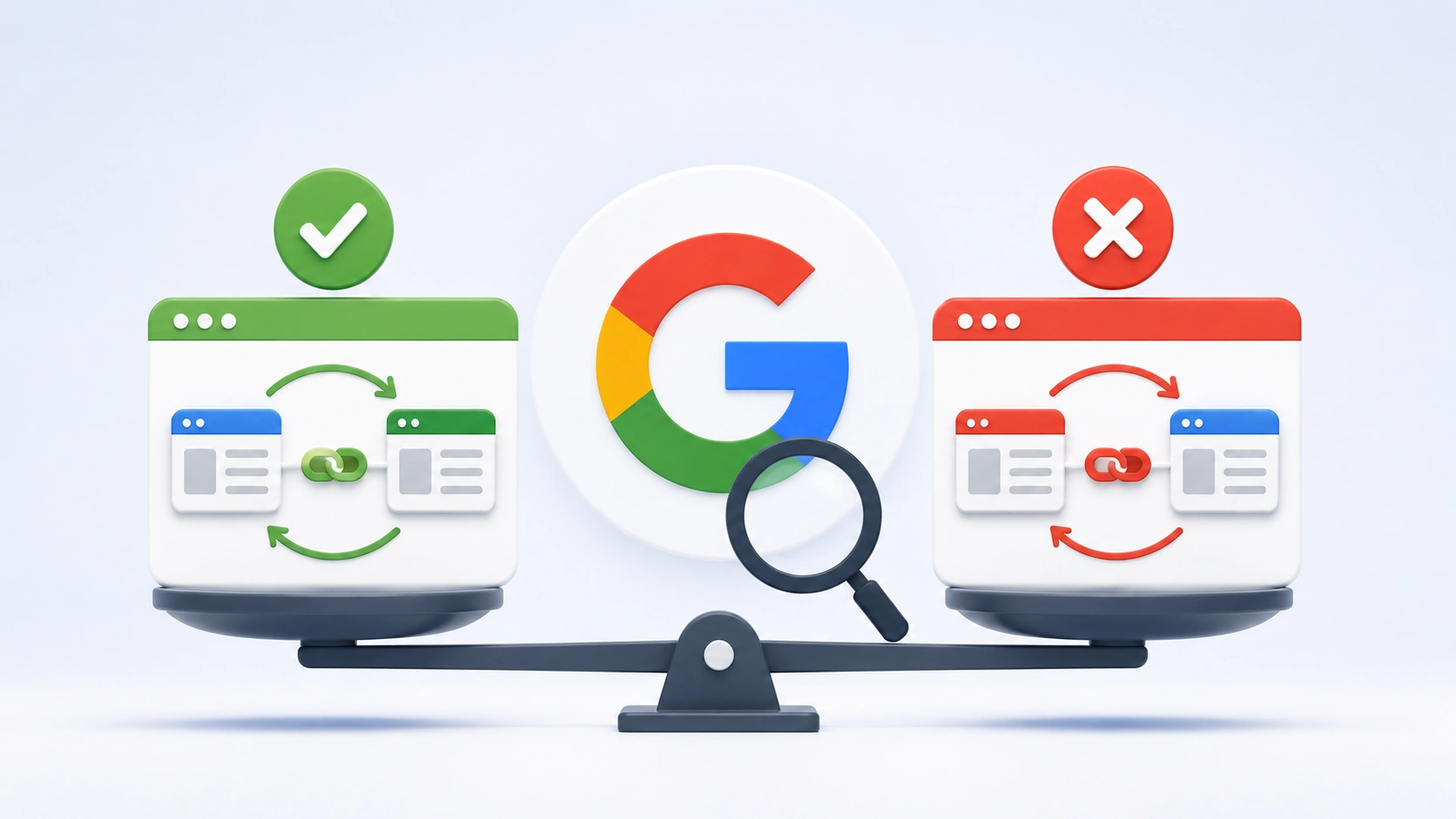
Yes — under four conditions, and it fails predictably when any of them are missing. Here is how link exchange works mechanically, why the economics beat outreach, and how to tell within ninety days whether it is working for you.
Two questions are usually asked together and they have different answers.
How does it work is mechanical and takes a paragraph.
Does it work is the real question, and the honest answer is conditional: it works when four things hold, and it produces nothing when they do not. Most people who conclude link exchange does not work were missing one of the four. That is worth knowing before you decide either way.
How link exchange works, mechanically
Two sites in related niches link to each other’s content, editorially, inside real articles that real people read. That is the whole mechanism, and it does not have to be a direct swap. On a marketplace you post what you want — the page you need linked, your niche, the minimum authority you will accept — and any publisher meeting those criteria takes the offer. The two sites are matched on relevance rather than locked into a mutual pair. That distinction matters more than it sounds, and it comes up again below. The practical sequence:
- You define what you want. Target page, niche and adjacent niches, minimum DR, minimum traffic
- A relevant publisher takes it — either because they were matched to you or because they saw your criteria and they fit
- Both links go into existing content, in the body, where the reference makes sense to a reader
- The placement is confirmed and monitored, because links come down over time and you want to know when
No pitch, no persuasion, no waiting on a reply that never comes.
Why it works: the persuasion step does not exist
Every other outreach-based tactic has the same structural problem. You are asking a stranger to do something that benefits you and costs them, with nothing offered in return. That is a bad offer, and no template fixes a bad offer. It is why cold outreach reply rates collapsed — once anyone could generate a thousand personalised-looking emails, the effort that made personalisation meaningful stopped being visible, and recipients started ignoring all of it. Exchange removes that problem rather than optimising around it, which is why it sits where it does on effort and risk in the how to get backlinks ranking. The publisher on the other end is not doing you a favour. They came to the same place wanting the same thing, and the answer is yes before the conversation starts. Two consequences follow.
Effort stops scaling with volume. A hundred links through outreach is roughly a hundred times the emails. Through criteria-based matching it is close to the same work as one, because the work happens once when you define what you want.
The cost is an asset rather than time. You give an outbound link slot on a page you already own. That is a real cost — it is worth pricing — and it is paid once rather than renewed.
The four conditions it depends on
This is where the answer becomes conditional, and it is the part worth reading twice.
1. Relevance. The linking site sits in your niche or a genuinely adjacent one. A project management blog linking to a productivity site makes sense to a reader and to a crawler. The same blog linking to a casino affiliate does not, and no amount of anchor engineering fixes it. Adjacent is usually better than exact. Your closest competitors are the sites least likely to trade with you.
2. Placement in real content. The link sits in the body of an article where it adds something — a reference, a source, a deeper explanation. Not stranded in a footer, a sidebar, or a partner page. Template links appear on every page and are discounted accordingly.
3. Moderate pace. A handful of well-matched exchanges a month reads as normal publishing. Twenty in a fortnight, all pointing at one page, does not. Google’s spam policies name excessive link exchanges specifically, and the operative word is the one doing the work — coordination at volume is the problem, not the existence of mutual links.
4. Partner quality. Real traffic, real content, and a clean outbound profile. A site linking out to four hundred unrelated commercial domains is selling placements to everyone, and the page your link lands on degrades every month they keep selling. The full operating framework sits in the link exchange guide.
Get all four right and this works. Miss one and you have either wasted effort or built a pattern. Those are the two failure modes and they are both avoidable.
When it does not work
Four situations, in order of how often they are the actual cause.
Your target page is thin. A four-paragraph service page with a contact form does not get taken, whatever the terms, because publishers look at what they are being asked to link to. Fix the page before adjusting anything else.
Your criteria are too narrow. An exact-niche requirement plus a high DR floor produces an empty queue. Widen the adjacency band before lowering the DR floor — relevance is the cheaper variable and it outperforms authority anyway.
You have nothing to trade. A very new site with no authority and no traffic is a poor partner. At that stage the higher-return work is internal linking and the relationships you already have. The DR gap is unrealistic. Sites more than roughly ten to fifteen points above you have little reason to trade, because the value moves one way and they know it. Setting a floor there means nothing happens.
What to expect, on a calendar
Expectations end more link building programmes than execution does.
Weeks 1–2. Setup and first placements. Feels productive.
Weeks 3–6. Nothing visible. Links are live, rankings have not moved, and the dashboard looks the same on Thursday as Monday. This is the stretch where people quit. What is actually happening: search engines have to discover the link, crawl it, and weigh it against everything else pointing at that page. None of those steps run on your schedule, and the weighing is slow by design — a system that revalued pages instantly would be trivial to manipulate.
Weeks 6–12. First movement, usually on pages already sitting at positions 11–20. That band moves first because it needs the least push.
Month 3 onward. Compounding, if the pace held and the standard did not slip. The single biggest predictor of whether this works is not your DR, your niche, or your settings. It is whether you are still placing links in week five.
How to tell whether it is working
Four numbers, and only one of them is available early.
Referral traffic per link — available immediately, and the only honest early signal. A partner sending real visitors is demonstrably a real site with a real audience. Partners sending nothing over two quarters are worth dropping regardless of their metrics.
Position on the specific target URL — not sitewide traffic, which is contaminated by everything else you did.
Referring domains, not backlinks. Fifty links from one site is one relationship.
Link survival rate. How many of the links you built six months ago are still live. Links disappear through redesigns, content pruning, and expired domains, and if nothing is checking, your real referring domain count is lower than your dashboard says. This is the number nobody reports and it is the one that turns a count into an asset.
Where the plugin fits
Everything above is doable by hand. It is just slow — finding relevant partners, checking DR and outbound profiles one at a time, agreeing terms, confirming both sides delivered, then monitoring indefinitely for removals. Linkexchange runs that cycle from inside your WordPress dashboard. You define the campaign — target page, niche, DR floor — and qualifying publishers take the offer, which also means the resulting links are not mutual pairs by default. Exchanges settle through credits, referral traffic is attributed per link so you can see which partners send actual people, and placements are monitored so a removed link surfaces immediately rather than at an audit next year. The internal linking tools are included free. Analysis costs nothing — orphan pages, weak pages, authority flow, content gaps, and the specific connections your site is missing. Acting on a couple of hundred opportunities by hand is an afternoon; bulk apply does it in one click on the paid tier. Either way you see the full picture before spending anything, which is usually worth doing before chasing external links at all.
The short answer
Yes, it works, and the conditions are not optional. Relevant partners, links inside real content, a moderate pace, and sites with real traffic and clean outbound profiles. That combination produces links that would look unremarkable to anyone reading the pages, which is the only durable definition of a good link. Miss those and you get the two failure modes: effort that produces nothing, or a pattern that produces worse than nothing. Neither is a property of link exchange. Both are properties of doing it without standards — and that is unusually easy to get right here, because you control both sides of the trade.