

Running link building for one site is a tactic. Running it for twelve is an operations problem — and the thing that breaks first is not quality, it is convergence. Here is how portfolio-scale programmes fail and what to build instead.
An agency managing a dozen client accounts is not doing the same job twelve times. The individual tactics are identical. The failure modes are entirely different.
A single site can run a mediocre link programme and get mediocre results. A portfolio running the same programme across twelve accounts produces something that no individual account owner can see and that shows up as a pattern only when someone looks across all of them at once.
The failure that defines portfolio work
Convergence. Everything else in this article is downstream of it.
The same team, using the same tools, applying the same house standards, with the same partner relationships, produces twelve link profiles that resemble each other. Similar partner pools. Similar anchor conventions. Similar acquisition curves. Similar placement positions.
None of that is visible from inside any single account, where everything looks reasonable. It is only legible from above, which is exactly the vantage point a link graph provides.
The most damaging version is a shared partner pool. If twelve accounts draw from the same set of partners, you have not built twelve link profiles. You have built one, twelve times — and a problem with one account becomes a problem with all of them simultaneously. That is the portfolio version of the footprint problem the advanced link exchange strategy guide covers at single-site scale.
Partner allocation, which is the core control
Treat the partner pool as a resource to be divided rather than shared.
- Assign partners primarily to one account. Overlap should be the exception and should have an editorial reason you could state out loud
- Cap overlap explicitly. Set a maximum percentage of shared referring domains between any two accounts. Pick the number, write it down, and enforce it in your process rather than in your intentions
- Vary pool composition. Different DR distributions, different niches within each account’s adjacency band, different geographies where relevant. Two clients should not have sibling profiles
- Never cross-link clients. Two accounts in adjacent niches linking to each other looks efficient and is a private network with an invoice trail
- Maintain an overlap matrix. Which partners appear on which accounts, updated as placements go live. This becomes unmanageable manually somewhere around the fourth account, which is where tooling stops being convenient and becomes necessary
House standards versus per-account standards
Agencies naturally develop house standards — a DR floor, an anchor split, a monthly target — because consistency is how you deliver reliably across a team.
That consistency is the problem.
Set thresholds per account, not per agency. A DR 30 floor is aggressive for a DR 15 client and conservative for a DR 55 one. Applying one standard produces two failures at once: unreachable targets on the small accounts and wasted opportunity on the large ones.
Vary anchor conventions. If every account uses the same partial-match construction, that phrasing is a signature. Different accounts should read as though different people wrote them, because in a healthy web they would have.
Offset acquisition calendars. If your team runs a monthly cycle, twelve accounts accelerate in the same fortnight and go quiet in the same week. Stagger the cycles deliberately.
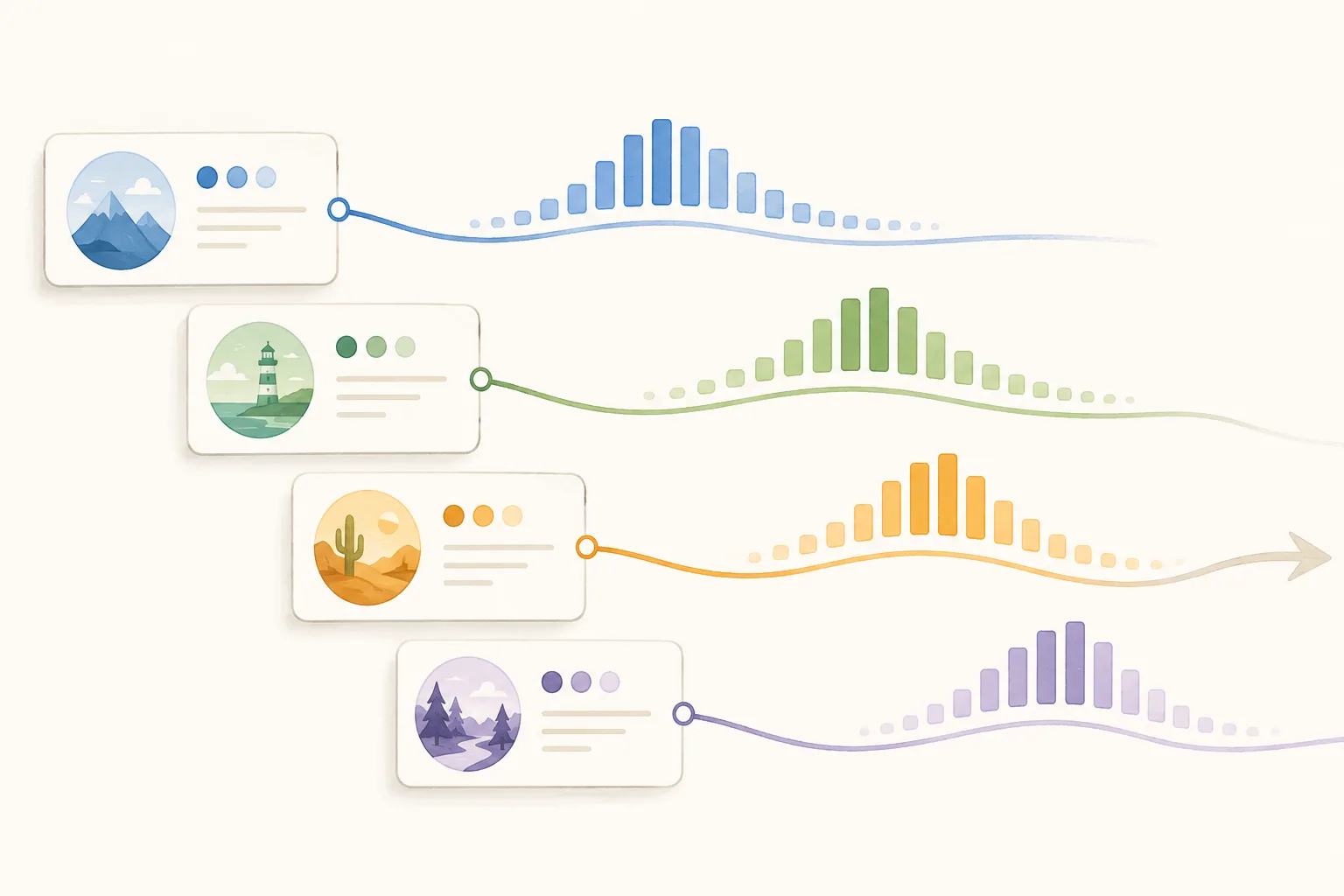
These controls interact, and the interaction matters more than any of them individually.
What the process actually needs
Six things, and most agencies have three of them.
A per-account brief that does not change monthly. Niche and adjacency band, DR floor, minimum traffic, anchor distribution targets per commercial URL, monthly acquisition range, and target page rotation. Written down at the start, referred to when someone is tempted by a borderline match at 5pm on a Friday.
An intake process for partners. Who checked this site, when, against what criteria. Partner quality is not a fixed property — a site clean last year may be selling placements now — so the record matters as much as the check.
A placement log. Which account, which target URL, which anchor, which date, which partner. This is the raw material for every audit below and it is the thing most commonly kept in someone’s head.
A monitoring system. Links disappear continuously. Without checking, every account’s reported referring domain count drifts above reality, and the drift compounds monthly.
A quarterly audit cadence. Per account and, critically, across accounts.
An escalation rule. What happens when a partner site degrades, when an account’s anchor ratio drifts, or when a client asks for something outside the brief.
The audit nobody runs
Per-account audits are standard. The cross-account audit is the one that catches convergence, and almost nobody does it because no client is paying for it.
Quarterly, across the whole portfolio:
- Overlap matrix. Which partners appear on more than one account, and at what percentage of each account’s profile
- Curve comparison. Plot all accounts’ monthly acquisition on one chart. Synchronised movement is the signal
- Anchor convention comparison. Do your accounts share phrasing habits? Read fifteen anchors from each account side by side
- Placement position comparison. If every account’s links sit in the third paragraph, that is a structural signature
- Partner drift. Which previously clean partners have started selling placements or publishing generated filler, across every account at once
The first two catch most of it, and both are half an hour of work with a decent placement log.
Reporting: what to show and what most agencies hide
Report survival, not just acquisition. Links built is the flattering number and it decays after you send it. Links still live is the honest one. An agency reporting acquisition without survival is reporting a figure that gets less true every month, and a client who eventually notices will not be reassured by the explanation.
Report referring domains, not backlinks. Fifty links from one site is one relationship. Backlink counts inflate profiles by a factor that varies by client, which makes them incomparable even within your own portfolio.

Report referral traffic per link. The one directly attributable business outcome available. It also proves partners are real sites with real audiences, which is a claim worth being able to substantiate — and it is one of the measurement disciplines the advanced link exchange strategy guide treats as part of the audit rather than as reporting decoration.
Report position movement on the specific target URLs rather than sitewide traffic, which is contaminated by everything else the client did.
Be honest about attribution. Proving a specific link caused a specific ranking change is not possible cleanly. Hold-out target pages — building to some and deliberately not others of similar profile — is the closest thing to a real experiment available, and it is worth running on at least one account so you have something defensible to say.
The team structure question
How you organise people determines how much convergence you produce, and this is rarely treated as a strategy decision.
One person per account produces the most differentiated profiles, because individual habits vary. It also scales worst and creates single points of failure when someone leaves.
One person per function — a prospector, a placer, a reporter, working across all accounts — scales best and produces the most convergence, because one person’s judgement is applied uniformly to everything.
The workable middle is functional specialisation with per-account standards written down and enforced in process. The prospector works across accounts but against different briefs. The person writing anchors has different conventions specified per client rather than choosing from habit.
Two practical measures worth taking regardless of structure:
- Rotate who handles which accounts periodically. It breaks up habitual patterns and it also cross-trains the team
- Have someone other than the account owner run the quarterly audit. The person who built a profile is the worst person to notice what is odd about it
Two conversations worth having early
The volume conversation. Clients ask for more links. The defensible answer is proportional — an account with 40 referring domains cannot absorb what an account with 400 can, and delivering the number they asked for is worse service than explaining why the number is wrong. Have that conversation at the start rather than at the audit.
The ownership conversation. When an engagement ends, the client keeps the links and you keep the partner relationships. Both parties should understand that going in, because the alternative is a dispute at the worst possible moment.
Where tooling stops being optional
The overlap matrix alone becomes unmanageable around the fourth account. Continuous monitoring across twelve accounts is not something anyone does reliably by hand. Anchor distribution per commercial URL across an entire portfolio is arithmetic at a scale that invites errors.
That is the case for tooling, and it is a genuine one. What tooling does not do is set your thresholds. Your DR floors, overlap caps, velocity ranges, and anchor targets are strategy decisions — the full set is covered in the multi-site link building guide — and a system executing bad thresholds efficiently is worse than no system, because volume makes a pattern more legible rather than less.
The division that works is the same one that applies at single-site scale: software handles the volume work — scanning, matching, settlement, monitoring, arithmetic — and a human decides what the standards are and reviews the shortlist.