
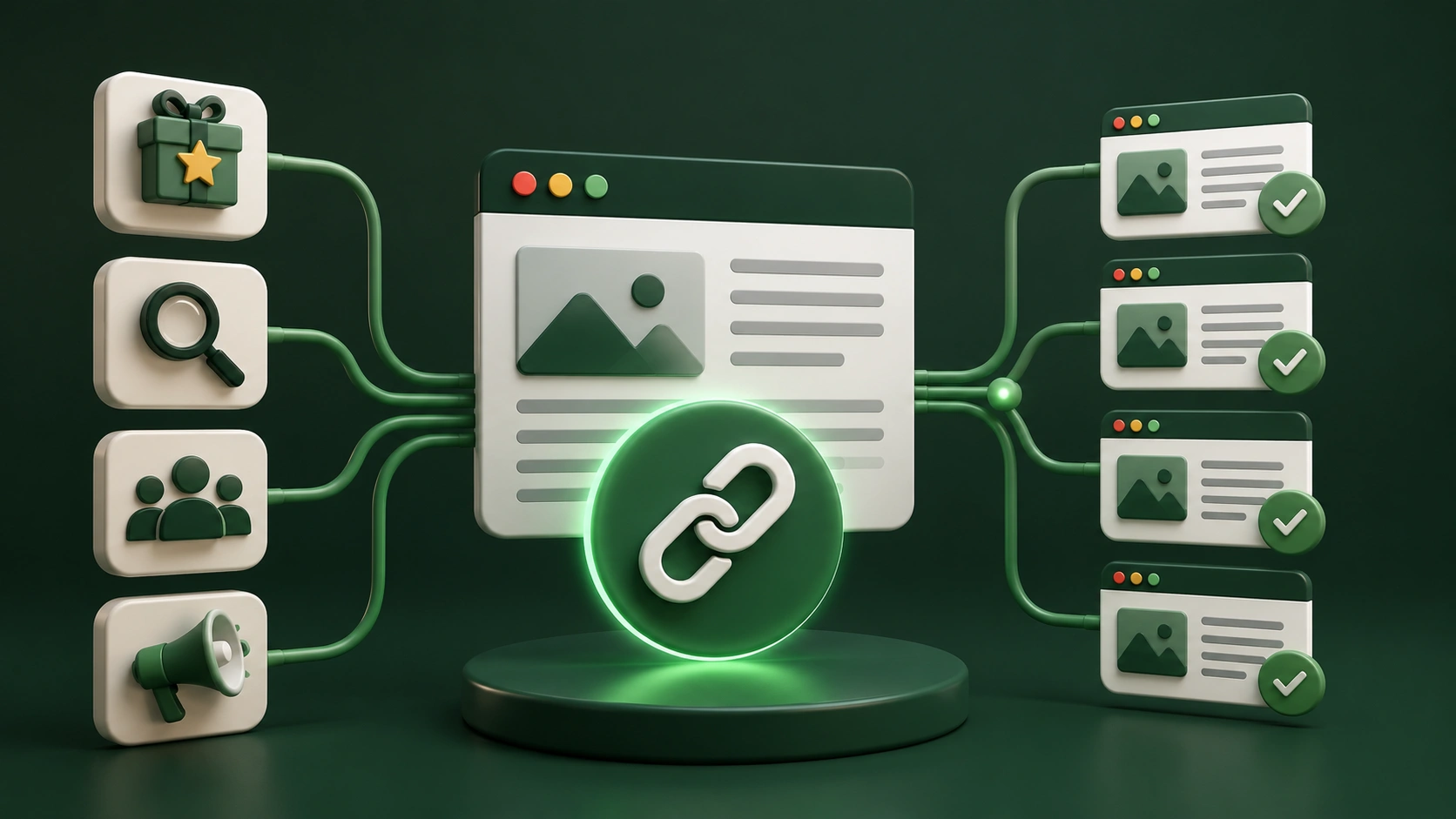
How to get backlinks without cold outreach: it is a persuasion problem wrapped around a matching problem, and solving the matching makes the persuasion disappear. Here is what automated niche matching evaluates before it puts two sites together.
Every link building guide eventually arrives at the same instruction: build a prospect list, find the contact, write a personalised pitch, send it, follow up twice.
It is worth asking why that is the default, because it is a strange thing to do. You are contacting a stranger, who did not ask to hear from you, to request a favour that benefits you and costs them, with nothing offered in return. Then you are surprised when the reply rate is dismal.
The reply rate is dismal because the offer is bad. No template fixes a bad offer — which is why building backlinks without cold outreach starts by removing the ask entirely.
What cold outreach is actually trying to do: discovery, qualification, agreement
Strip the emails away and cold outreach is three separate jobs bolted together.
Discovery. Find sites that are relevant to yours and plausibly willing to link. This is a search problem.
Qualification. Work out whether a given site is worth a link from — authority, real traffic, clean outbound profile, genuine content rather than a farm. This is an evaluation problem.
Agreement. Get both parties to actually do the thing. This is a coordination problem.
Notice that only the third one involves a human conversation, and even then, only because there is no shared system for expressing “I want links and I am willing to give them.” Everyone in the industry wants the same thing. Nobody has a way to signal it, so they signal it by emailing each other one at a time, badly.
Cold outreach is what a matching problem looks like when there is no marketplace.
Why the persuasion step disappears entirely once matching is solved
Here is the part that changes the economics. When you email a stranger, you have to convince them. When you are matched with someone who joined a network specifically because they want links, the answer is already yes before the conversation starts.
There is nothing to persuade. You are not asking for a favour, you are completing a trade that both sides came looking for. The email you would have spent twenty minutes writing does not need to exist.
That is the entire argument for matching over pitching, and it is why the effort curve is so different. Outreach effort scales linearly — a hundred links means roughly a hundred times the emails. Matching effort is close to flat, because the work is done once when you define what you want.
What good automated matching actually evaluates before pairing two sites
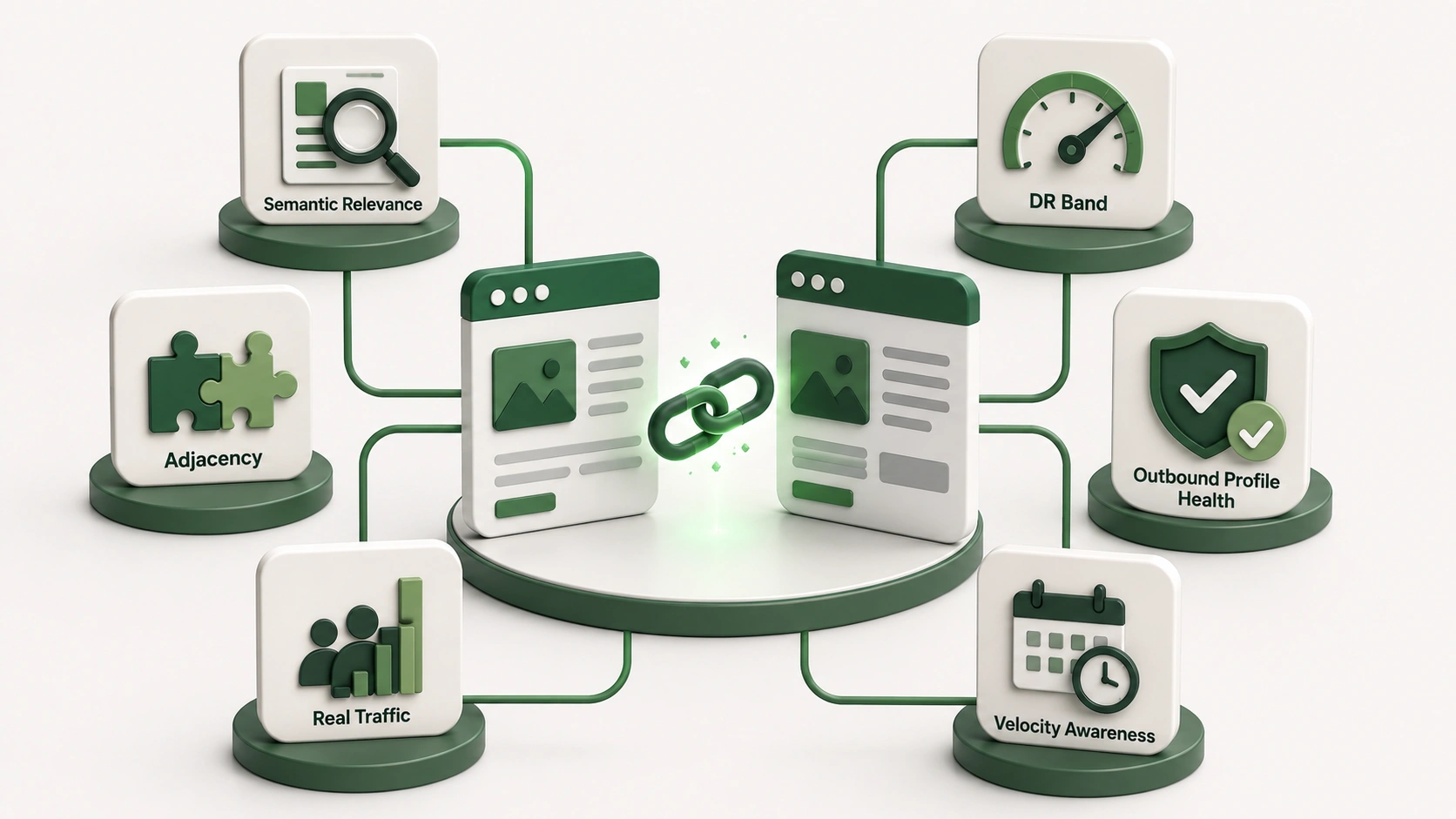
“AI matching” is a phrase that means nothing on its own. So rather than asking you to take anyone’s word for it — ours included — here are the six things worth interrogating in any matching tool before you trust it with your link profile. Ask vendors these directly.
Semantic relevance, not category tags. Crude matching sorts sites into buckets — “marketing,” “finance,” “health” — and pairs within the bucket. That is too blunt. A site about email deliverability and a site about CRM software are both “marketing” but are only loosely related, while a site about email deliverability and one about cold outreach tooling are genuinely adjacent despite sitting in different categories. Matching on what content is actually about, rather than what label it was given, is the difference between a link that makes sense to a reader and one that does not.
Adjacency, deliberately. Exact-niche matching sounds ideal and is actually a trap. Your closest competitors are the sites least likely to link to you. The useful zone is one step out — related enough to be relevant, not so close that you are fighting for the same customers.
DR band, in both directions. You want a floor, obviously. You also want to understand that a site far above your level has little reason to trade with you. Realistic matching pairs sites within a range where the exchange is mutually worthwhile, rather than surfacing DR 80 domains you will never actually secure.
Outbound profile health. This is the check most people skip and the one that matters most. A site with a clean outbound profile links to a modest number of relevant places. A site linking out to hundreds of unrelated domains is either selling placements or has been compromised, and a link from it is worth nothing at best. Any matching system worth using should be evaluating the neighbourhood a site keeps, not just its DR.
Real traffic. Authority without audience is half an asset. A site with genuine visitors sends you referral traffic alongside the ranking signal, and traffic is also the hardest metric to fake, which makes it a useful proxy for whether a site is real.
Velocity awareness. A site acquiring links at a rate wildly out of step with its size and history looks exactly like what that pattern implies. Whether the tool paces placements for you or leaves it to your own discipline, spreading exchanges over time beats delivering them all at once.
Why your own judgement still matters more than the matching model
One caution about automated matching, since the industry is currently overselling it.
A matching system is only as good as the signals it can see, and some of the most important signals are ones software reads poorly. Whether a site’s content is genuinely useful or merely present. Whether a publisher is someone you would want your brand associated with. Whether an article is a real piece of writing or a thin wrapper around an affiliate link. Automation is excellent at the volume work — scanning thousands of candidates, checking metrics, flagging outbound anomalies — and mediocre at the judgement work.
The right division of labour is that the system narrows thousands of possibilities to a shortlist, and you look at the shortlist. Anyone telling you to skip that second step is describing a product, not a strategy.
Four routes to backlinks that require no cold email at all
1. Exchange networks. Sites in related niches link to each other’s content, editorially, in real articles — either as a direct swap or, on a marketplace, by posting criteria and letting any qualifying publisher take the offer. The oldest method on this list and the most direct solution to the matching problem. The version that gets people in trouble is the old abuse pattern — reciprocal directories, partner pages built for cross-linking, high volume across unrelated industries. The version that works is relevant, in-content, moderate, and quality-controlled.
2. Unlinked mentions. Someone already wrote about you and did not link. Find these by searching your brand name and your founders’ names, then ask — this is not cold outreach, because they have already demonstrated they know who you are. That prior familiarity is why the ask converts far better than a cold pitch does.
3. Being referenceable. Publish something people need to cite: original data from your own product, a survey of your industry, a free calculator or tool, a definitive reference page. This is the slowest route and it produces the best links, because they arrive without being requested. If you have usage data nobody else has, you are sitting on the highest-value link asset available to you and probably not using it.
4. Existing relationships. Suppliers, clients, partners, associations, communities you belong to, tools you use and love. These people already know you. Most sites have a dozen uncollected links sitting in their own contact list, and almost nobody works through it systematically.
The honest limits of automated matching, and what it will not do for you
Matching does not solve everything, and it is worth being straight about where it stops.
It will not get you links from major publications — that is digital PR, and it needs a news hook and a budget. It does not replace being worth linking to; a network can put your page in front of a relevant publisher, but if the page is thin, nothing good happens. And it does not remove your judgement. A quality floor you set carelessly is a quality floor, and no automation protects you from your own settings.
It also is not free of the fundamentals. Relevance, in-content placement, moderate pace, and real quality still govern whether any of this works. Automation makes those rules easier to follow consistently. It does not repeal them.
Where Linkexchange fits: the matching layer running inside WordPress
Linkexchange is the matching layer, running inside your WordPress dashboard.
You define the campaign: your niche, the pages you want links to, the DR floor you will accept. The platform handles discovery and qualification from there, surfacing partner sites that fit rather than leaving you to assemble a prospect list by hand. Exchanges settle through a credit system, every link is monitored continuously so you find out when one comes down, and referral traffic is attributed per link so you can see which partners send actual people rather than just authority.
What you do not do at any point is write an email to a stranger.
The point is not that automation is clever. It is that the entire outreach apparatus — the prospect lists, the templates, the follow-up sequences, the tracking spreadsheet — exists to solve a problem that a marketplace makes disappear. When both sides have already said yes, there is nothing left to pitch.
Get started free at linkexchange.ai — 500 credits, no card required. Exchange smarter. Rank higher.