Do backlinks still matter now that AI answers sit above the results for roughly half of all queries? Clicks have collapsed, which should have made link building irrelevant. Instead it changed what links buy you — from traffic to eligibility.
Figures in this article are current as of August 2026. This area is moving fast enough that studies six months apart describe meaningfully different systems — check the sources before quoting any of it.
The argument that link building is finished has never had better evidence behind it than it does right now.
Google’s AI Overviews appear on a large and growing share of queries. BrightEdge data puts them on around 48% of tracked queries as of early 2026, up from about 31% a year earlier. Ahrefs measured a 58% drop in click-through rate for top-ranking pages on queries where an AI Overview appears — roughly double the decline they recorded in April 2025. Pew Research found users click a traditional result on about 8% of searches with an AI Overview present, against 15% without. Chartbeat put the global decline in search referrals to publishers at about a third over a year.
If ranking first no longer produces the click, do backlinks still matter — and what exactly is one buying?
It is a fair question and the answer is not “nothing.” But it is also not what it was two years ago.
The gap between being cited in the AI answer and being bypassed entirely
Buried in the same research is the finding that reframes everything.
Seer Interactive’s 2026 analysis found that brands cited inside AI Overviews earn substantially more organic clicks per impression than uncited brands on the same queries — their figure is around 120%. The traffic did not disappear. It concentrated. It moved from “everyone in the top ten gets a share” to “the sources named in the answer take most of it, and everyone else takes almost none.”
That is the actual shift. Not the death of search traffic, but a redistribution of it toward a much smaller set of winners on each query. Which makes the operative question no longer “how do I rank” but “how do I become one of the sources the answer is built from.”
What the 2026 studies actually say determines AI citation
This is where it gets genuinely interesting for anyone who builds links, because the research points in two directions at once.
Seer Interactive analysed roughly 10,000 questions across finance and SaaS and found a strong correlation — around 0.65 — between holding a Google first-page ranking and being mentioned by ChatGPT. Bing rankings correlated similarly. But the correlation between raw backlink quantity and LLM citations was very weak, around 0.10.
Read carelessly, that says links do not matter for AI visibility. Read properly, it says something more useful: links moved one step back in the chain rather than out of it.
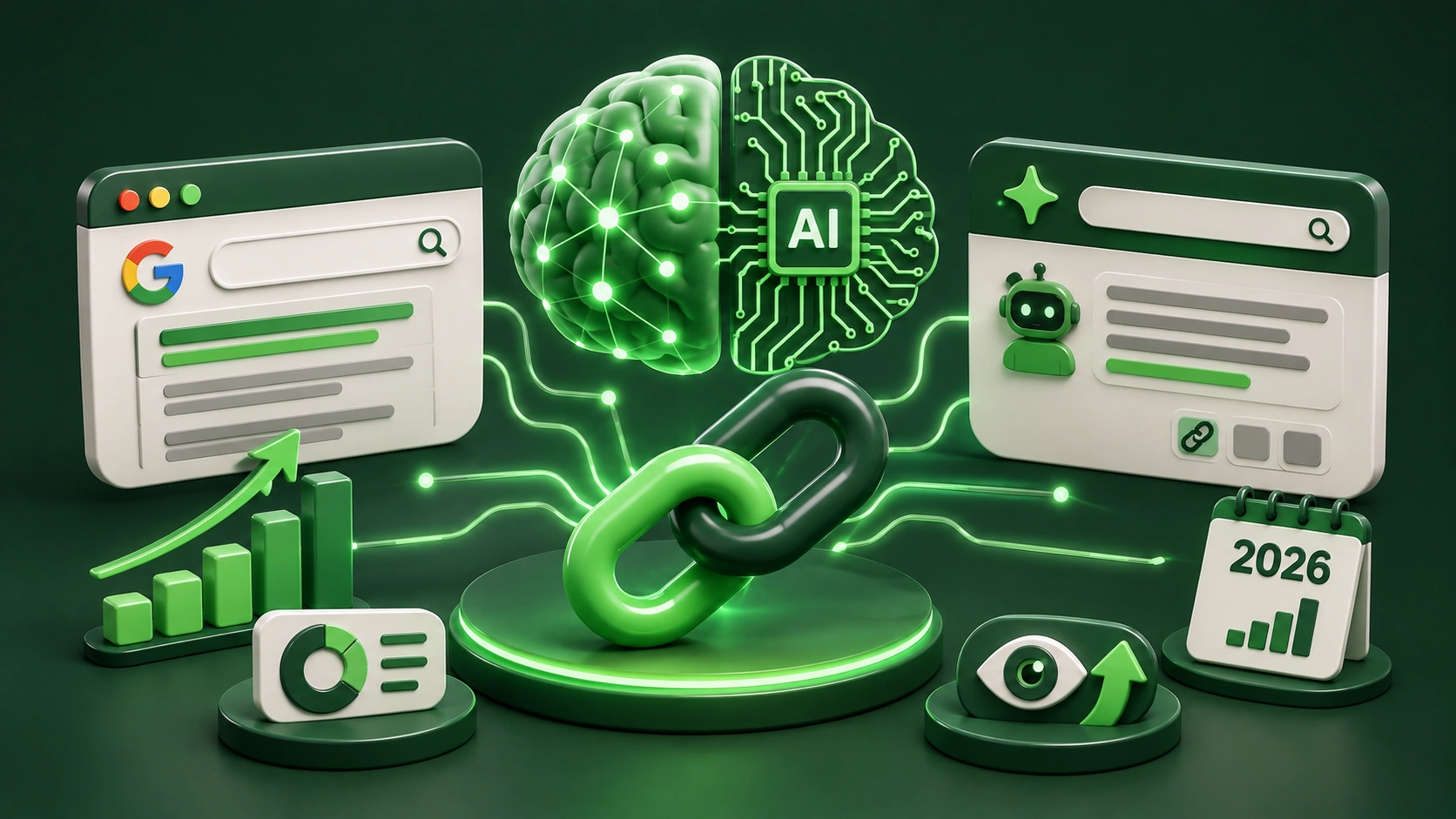
The chain runs links → rankings → citation eligibility. AI systems overwhelmingly draw their sources from pages that already rank well, so whatever gets you ranking still governs whether you are in the pool at all. Links do not correlate directly with citations because they were never a direct input. They are an input to the thing that is the direct input.
The corroborating figure: analyses of AI Overview citations have found a large majority — one commonly cited figure is around 76% — come from pages already sitting in the top ten organic results.
Where the research contradicts itself, and why that matters for strategy
Honesty requires flagging that the numbers do not all agree.
A Semrush analysis found that roughly 47% of sources cited in AI Overviews did not hold a top-ten organic position for that query. That sits awkwardly next to the 76% figure above. Different samples, different date ranges, different query sets, and a landscape changing fast enough that a study six months old describes a different system.
The practical reading of the disagreement is this: strong rankings make citation much more likely but do not guarantee it, and weak rankings make it less likely but not impossible. Passage-level clarity matters independently. If your page buries the answer under four hundred words of preamble, a clearer competitor with fewer links can be cited instead.
So links get you into the pool. Structure and clarity determine whether you get picked out of it.
The signal that grew fastest in 2026: unlinked brand mentions
The other consistent finding across 2026 research is that unlinked brand mentions punch above their weight for AI visibility specifically.
One analysis identified brand search volume as the strongest single predictor of AI citations in its dataset. Ahrefs-based research has reported brand mentions correlating with AI Overview placement at a substantially higher rate than backlinks do. The platforms that appear to matter most cluster in a few places — YouTube transcripts, Reddit threads, and established industry publications show up repeatedly in citation sets.
This matters for link building in a specific way. A mention without a link, which traditional SEO treated as a near-miss to be converted, now has independent value. The roundup that named you but did not link is no longer a failure. It is a different kind of asset.
It also means the two strategies converge more than they diverge. The work that earns a link — being genuinely referenceable, publishing data nobody else has, appearing in relevant conversations — is the same work that earns a mention.
What this actually changes about how you should be building links now
Relevance beats volume, harder than before. If links matter through rankings, and rankings increasingly reward topical authority, then twenty links from genuinely related sites do more than two hundred scattered ones. The old numbers game was always weak. It is now close to pointless.
Referral traffic became a primary metric, not a secondary one. When a link’s ranking contribution is mediated through several steps you cannot observe, the visitors it sends are the one effect you can measure directly. A link from a page with real readers pays whether or not the ranking maths works out. Track referral traffic per link.
Count mentions alongside links. If you are only measuring referring domains, you are missing a signal that current research suggests matters more for AI citation than the one you are measuring.
Be structurally citable. Clear claims near the top, answers before preamble, defined terms, structured data. This is cheap and it determines whether the eligibility your links bought you converts into an actual citation.
Original data is now the highest-leverage asset you can build. It earns links, earns mentions, and gets cited — three returns from one investment. If your product generates data nobody else has, that is your single best move.
AI on the other side of the desk: where it helps and where it made things worse
Two things are also happening to the process of link building, and they point in opposite directions.
Where AI genuinely helps. Prospecting and qualification are volume problems, which is exactly what automation is good at — scanning thousands of candidate sites, evaluating semantic relevance rather than crude category tags, flagging anomalous outbound profiles, checking whether a site’s content is substantive, and monitoring placements continuously so a removed link surfaces immediately rather than during an audit next year.
Where AI made things worse. Cheap generation made cold outreach dramatically worse for everyone. When anyone can produce a thousand personalised-looking pitches an hour, the personalisation signal that made outreach work stops carrying information. Inboxes adjusted. Reply rates fell. The tactic did not stop working because people got worse at it — it stopped working because it got too easy.
The same cheapness flooded the web with thin content, which raises the stakes on partner vetting. A DR 35 site that publishes forty generated articles a month is a worse link than its metrics suggest, and metrics alone will not tell you. Look at whether a site’s content reads like someone meant it.

Where Linkexchange fits: automating volume, leaving judgement with you
Linkexchange handles the volume half of that split from inside WordPress: matching you with sites in your niche at the DR floor you set, settling exchanges through credits, attributing referral traffic per link so you can see which partners send actual people, and monitoring placements so removals surface immediately.
The judgement half stays yours. Look at the shortlist. Read the partner site. Decide whether you would cite it yourself.
The short version: backlinks now buy eligibility rather than traffic
Backlinks did not stop mattering. They stopped mattering directly.
They now buy eligibility rather than traffic — a place in the pool of pages AI systems draw from. What converts eligibility into a citation is clarity, structure, topical depth, and brand presence. The sites winning in 2026 are doing both, and the ones that quit link building because the click economy broke are quietly losing the thing that got them considered in the first place.
Get started free at linkexchange.ai — 500 credits, no card required. Exchange smarter. Rank higher.