
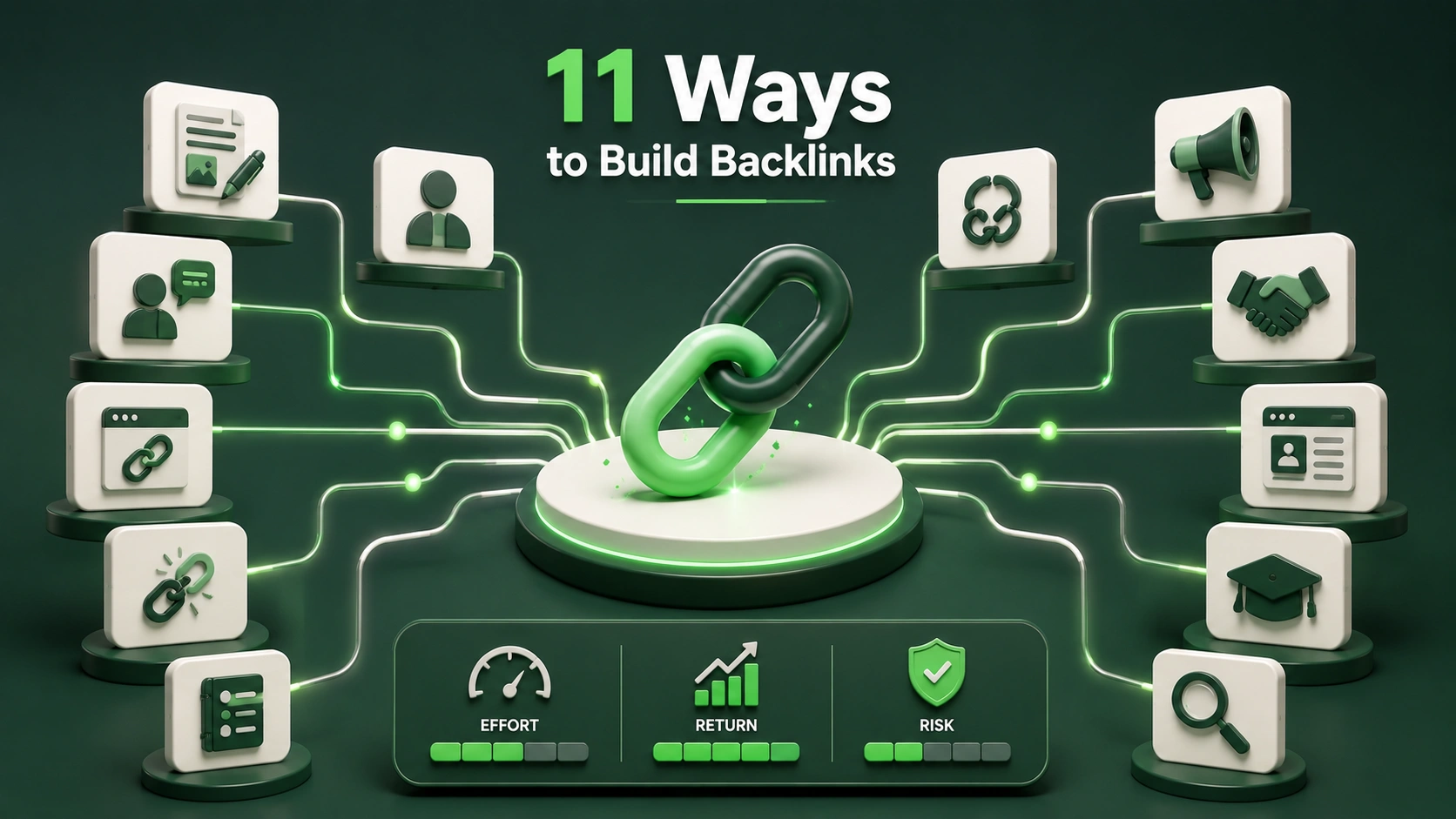
Most guides on how to get backlinks list every tactic as though they are equally available to you. They are not. Here is what each one really costs, what it returns, and which three you should run this quarter.
The problem with advice on how to get backlinks is not that it is wrong. It is that it is presented as a menu with no prices.
Digital PR, guest posting, broken link building, HARO, resource pages, original research — every guide lists them, none of them tell you that four require a budget, three require a team, and two will take you eight months to see a result from. So people pick whichever sounded most impressive, discover halfway through that they cannot sustain it, and conclude link building does not work.
This is the same list with the prices attached.
How to read this list: effort, return, risk, and scalability
Each tactic gets judged on four things:
- Effort — hours per link acquired, including the failures
- Return — quality of what you get when it works
- Risk — likelihood of it hurting you
- Scalability — whether ten links costs ten times what one link cost
Scalability is the one people miss. A tactic that produces excellent links at a fixed cost per link is a project, not a strategy. You need at least one thing in your mix where effort does not scale linearly.
Tier one: the backlinks you have already earned and never collected
1. Existing relationships. Suppliers, clients, partners, trade associations, professional bodies, your accountant, the agency that built your site, the tools you use and genuinely recommend. Most of these organisations have a partners page, a client list, or a case study programme, and most will link to you for the asking because a relationship already exists.
Effort: very low. Return: moderate and highly relevant. Risk: none. Scalability: capped — you have as many relationships as you have.
Almost nobody works through this list systematically. Do it in an afternoon before you spend money on anything else.
2. Unlinked mentions. Someone already wrote about you, your product, or your founder and did not link. Search your brand name, product name, and founders’ names, filter out your own properties, and check which mentions lack a link.
Effort: low. Return: good. Risk: none. Scalability: capped by how often you are mentioned.
The ask converts better than a cold pitch because the person has already demonstrated they know who you are. You are correcting an omission, not requesting a favour.
3. Reclaiming lost links. Links you used to have that disappeared — through redesigns, content pruning, or migrations that broke your URLs. Check for 404s with inbound links and redirect them properly.
Effort: low. Return: recovers value you already earned. Risk: none. Scalability: capped.
This trio is the cheapest work in link building and the most consistently skipped, because it is unglamorous and nobody sells a course about it.

Tier two: sustainable tactics you can realistically run every week
4. Link exchange. Sites in related niches link to each other’s content, editorially, inside real articles. The persuasion problem disappears because both sides want the same outcome before the conversation starts. It is not necessarily a direct swap — post your criteria and any qualifying publisher can take the offer, which also avoids the mutual-pair pattern that makes bilateral swapping detectable at volume.
Effort: low per link once matching is handled. Return: good when relevance and quality standards hold. Risk: moderate — depends entirely on execution. Scalability: high.
The risk is real and worth naming. Excessive link exchanges are called out explicitly in Google’s link spam policies, and the abuse pattern is well documented: reciprocal directories, partner pages built for cross-linking, high volume across unrelated industries. The version that works is relevant, placed in genuine content, moderate in pace, and limited to sites with real traffic and clean outbound profiles. The method is not the problem. Volume without standards is.
5. Resource page placements. Find pages that curate useful links in your niche — “best tools for X,” “resources for Y” — and pitch inclusion. Works when you have something genuinely worth curating.
Effort: moderate. Return: good, highly relevant, often durable. Risk: low. Scalability: moderate.
6. Broken link building. Find dead links on relevant pages, then offer your content as the replacement. The pitch is strong because you are fixing something for them.
Effort: high — most prospects yield nothing. Return: good. Risk: none. Scalability: poor.
Better as a supplementary tactic than a core one. The hit rate is low enough that it rarely justifies being anyone’s main plan.
7. Journalist request services. HARO-style platforms where reporters ask for expert comment. You answer, you occasionally get quoted with a link.
Effort: moderate and ongoing — you must respond fast and often. Return: occasionally excellent, mostly nothing. Risk: none. Scalability: poor.
Realistic expectation: a lot of unanswered responses for a small number of very good links. Worth it if you can delegate the monitoring.
Tier three: high return tactics that cost real time or real money
8. Guest posting. Still works. Pitch, get accepted, write 1,500 words for someone else’s site, wait for edits, wait for publication.
Effort: high — days per link. Return: good. Risk: low if the target is legitimate. Scalability: poor.
Reserve for two or three publications you genuinely want to appear on. Treating it as a volume play means writing content nobody reads for sites nobody trusts.

9. Original data and research. Survey your industry, publish usage data from your own product, build a free calculator or reference tool. Then let people cite it.
Effort: very high upfront. Return: the best links available to a site without a PR budget. Risk: none. Scalability: excellent — one asset earns links for years without further work.
This is the one to build if you can only build one. If you run a product that generates data nobody else has, you are sitting on the highest-value link asset you own and probably not using it.
10. Digital PR. A genuine news hook, pitched to journalists, producing coverage in real publications.
Effort: very high, usually requires an agency or a dedicated person. Return: the best links, full stop. Risk: low. Scalability: budget-dependent.
Park this until you have the budget. It is not a starting point.
11. Podcasts, interviews, and communities. Appear on relevant shows, contribute genuinely to industry communities, answer questions where your expertise is real.
Effort: moderate and ongoing. Return: moderate links, strong secondary benefits. Risk: none. Scalability: moderate.
The links are often no-follow. The referral traffic and reputation are frequently worth more than the link would have been.

The tactic nobody lists: make the page worth linking to first
Every item above is a way of getting a link in front of someone. None of them fix the underlying question of whether the page is worth linking to.
If the target page is a thin service page with four paragraphs and a contact form, no tactic on this list performs well, because every one of them ultimately requires a human to decide your page is worth pointing at. Outreach fails, resource pages decline you, exchange partners take the deal and place your link somewhere that does not matter.
Before running any of this, look at the page you are building links to and ask whether you would link to it from your own site. If the answer is no, fix that first. It is cheaper than every alternative on this page.
What to skip entirely, no matter how cheap it looks
- Sites whose business is selling placements, and PBNs. The problem is not that money is involved. It is that a seller has no reason to limit volume — more placements is simply more revenue — so the page your link lands on degrades every month they keep selling. When a seller network gets identified, everything you bought from it drops at once. Judge any platform on whether it constrains what gets placed and on whom, not on whether it is free.
- Bulk directory submissions. Directories that accept everyone are read as spam. Industry-specific and geographic directories with actual editorial standards are fine.
- Comment and forum signature links. No-follow, ignored, and a signal of desperation.
- Anything promising hundreds of links for a flat fee. The arithmetic does not work at that price unless the links are worthless.
How to build a link building mix that survives contact with your calendar
Pick three. Not eight.
- One collection tactic from tier one — a single afternoon, done once, gets you started with links you already earned.
- One sustainable tactic from tier two that you can run every week without heroics. This is your engine.
- One asset build from tier three, running slowly in the background. This is the thing that eventually makes the other two unnecessary.
A realistic quarter looks like: relationships and unlinked mentions cleared in week one, an ongoing exchange or resource-page programme running weekly from week two, and one piece of original research shipping around month three.
That is it. Three tactics, executed consistently, beats eleven attempted once.
One thing that is not on this list and should be running underneath all of it: your internal links. It acquires no new referring domains, which is why it is not a tactic here, but it is the only lever that improves rankings at zero cost and without anyone else’s permission. Route authority from your strongest existing pages to the ones you are building links to, and every external link you earn afterwards works harder.
Track what survives, not just what you managed to build
Whatever mix you choose, monitor it. Links disappear through redesigns, content pruning, expired domains, and quiet SEO cleanups. Link rot is the default outcome for any programme without monitoring, and six months on you will not know which of your links are still live unless something is checking.
Track referring domains rather than total links, positions on the specific pages you targeted, referral traffic per link, and survival rate.
Where Linkexchange fits: automating the sustainable engine slot
Linkexchange automates tactic four — the sustainable engine slot in your mix. It runs inside WordPress, matches you with sites in your niche at the DR floor you set, settles exchanges through credits, attributes referral traffic per link, and monitors placements continuously so removals surface immediately. Internal linking recommendations are included free, whether or not you use the exchange side.
It is not a replacement for the other ten. It is the one that scales, which is what you want in the slot you run every week.
Get started free at linkexchange.ai — 500 credits, no card required. Exchange smarter. Rank higher.