
Link building for beginners, in plain English: what makes a backlink worth having, how many you actually need, and where to begin without wasting six months.
Most link building advice is written for people who already build links. It assumes you know what DR means, that you have a prospecting workflow, and that “just do digital PR” is a sentence containing actionable information.
This guide assumes none of that. Link building for beginners should start with what a link is and why it counts — so if you have a website, you have heard that backlinks matter, and you have no idea what to actually do on Monday morning, start here.
What a backlink actually is, and why search engines treat links as votes
A backlink is a link on someone else’s website that points to yours. That is the whole definition.
Search engines treat these links as votes. The original insight behind Google was that if a lot of independent sites reference a page, that page is probably worth reading — and the more trusted the site doing the referencing, the more its vote counts. Two decades of refinement later, that basic idea still underpins ranking.
This is why you cannot fully rank on content alone. You can write the best guide on the internet about commercial roofing, and if nobody links to it, search engines have very little external evidence that it deserves to outrank a worse guide on a site that fifty roofing publications reference. Content gets you eligible. Links get you competitive.
The five things that separate a valuable backlink from a worthless one
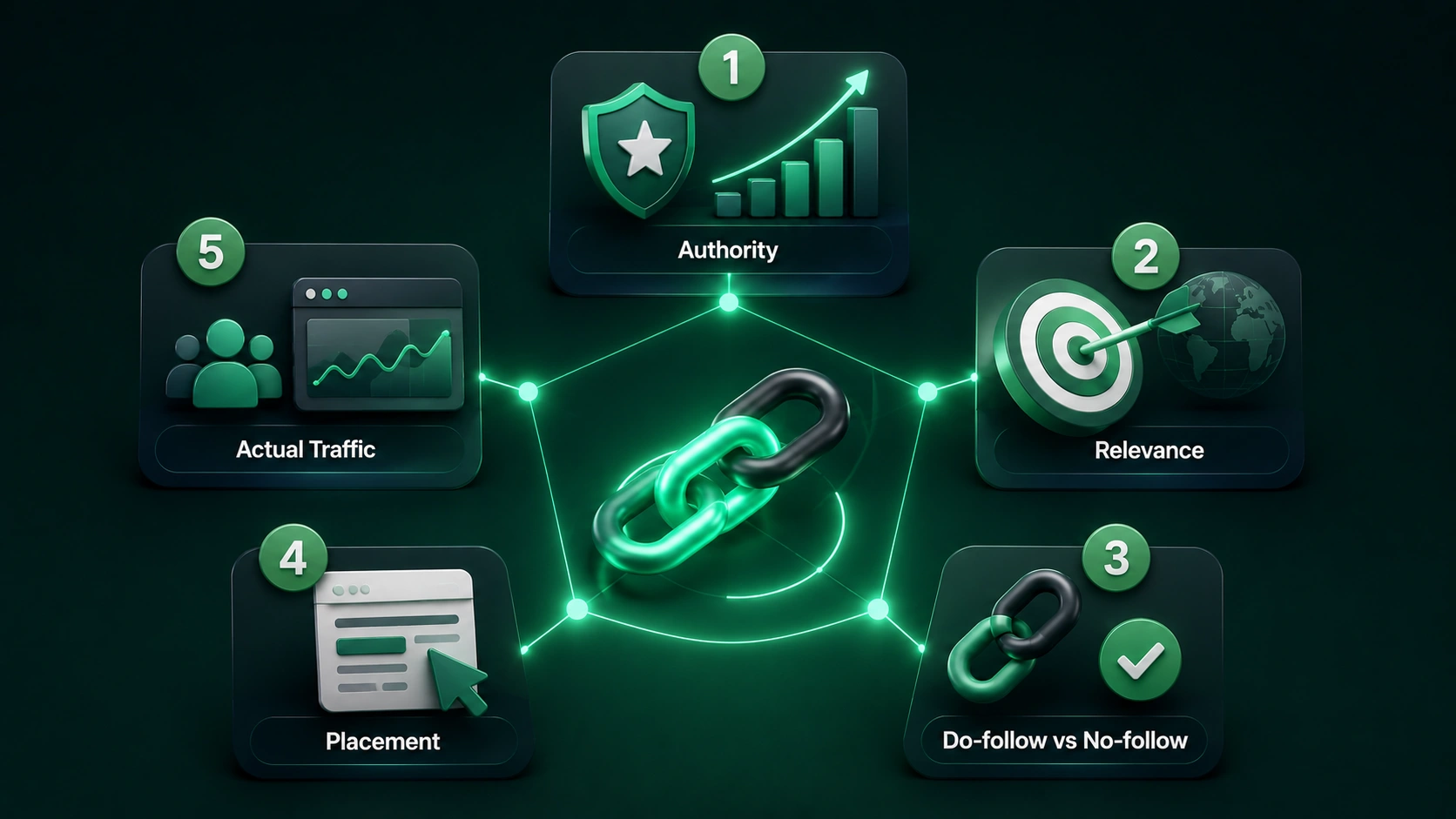
Not all links are equal, and the gap between a good one and a worthless one is enormous. Five variables do most of the work.
1. Authority of the linking site. Usually measured as Domain Rating (DR) or Domain Authority (DA), on a 0–100 scale. These are third-party estimates from tools like Ahrefs and Moz, not numbers Google publishes. A link from a DR 70 site passes far more value than one from DR 5.
Be careful how you read the scale — it is logarithmic, not linear. Going from DR 20 to DR 30 is a very different amount of work than going from DR 60 to DR 70. And a DR 18 site is a weak site, even if some dashboard shows the number in a reassuring colour.
2. Relevance. A link from a site in your industry is worth more than a link from an unrelated one, even at the same DR. A roofing supplier linking to your roofing company makes sense to a reader. A pet grooming blog linking to it does not, and search engines are good at noticing that.
Adjacent counts. Construction, home improvement, and property management are all reasonable neighbours for roofing. You do not need an exact match.
3. Do-follow versus no-follow. By default, links pass authority. A rel="nofollow" or rel="sponsored" attribute tells search engines not to count it as an endorsement. Most social media links, most comment sections, and most paid placements are no-follow.
No-follow links are not worthless — they send real traffic and they make your profile look natural — but they will not move rankings the way a do-follow link does. When someone offers you a link, this is the first thing to check.
4. Placement on the page. A link inside the body of an article carries more weight than one buried in a footer, sidebar, or author bio. Links surrounded by relevant text, in a position where a reader might actually click, are treated as more genuine — because they are.
5. Actual traffic. A link on a page nobody visits passes some authority and sends zero visitors. A link on a page with real readers does both. This is the metric beginners ignore most often, and it is the one most correlated with links that actually grow a business rather than just a number in a dashboard.
Three things beginners worry about far more than they need to
Exact-match anchor text. New link builders obsess over getting “commercial roofing contractor” as the clickable text. Over-optimising anchors is a well-known spam signal. Natural variation — your brand name, the page title, “this guide,” a bare URL — is safer and works fine.
Total link count. Ten relevant links from real sites will outperform four hundred from directories and comment sections. The number in your dashboard is vanity. The composition of it is the actual asset.
Speed. A brand new site acquiring two hundred links in a month looks exactly like what it is. Link velocity — the rate of acquisition — should look like the growth of a site people are gradually discovering.
The main link building methods, honestly ranked for someone starting out
Cold outreach. The default advice, and the worst starting point for a beginner. You are emailing strangers with no reputation, no case study, and no leverage, asking them for a favour. Response rates are low for experienced practitioners and near zero for newcomers. It works eventually. It will not work in your first month.
Buying placements. Fast, expensive, and against Google’s guidelines. The deeper problem is that sites selling links sell to everyone, so the page your link lands on gets progressively worse as they take more money. Skip it while you are learning, because you will not yet be able to tell a decent seller from a terrible one.
Guest posting. Legitimate and effective. Also slow — pitch, wait, write 1,500 words for someone else, wait for edits, wait for publication. That is days of work per link. Worth doing for two or three targets you genuinely want to be published on. Not a volume strategy.
Digital PR. The best links come from here. It also requires a genuine news hook, a budget, and usually a person whose job this is. Park it for later.
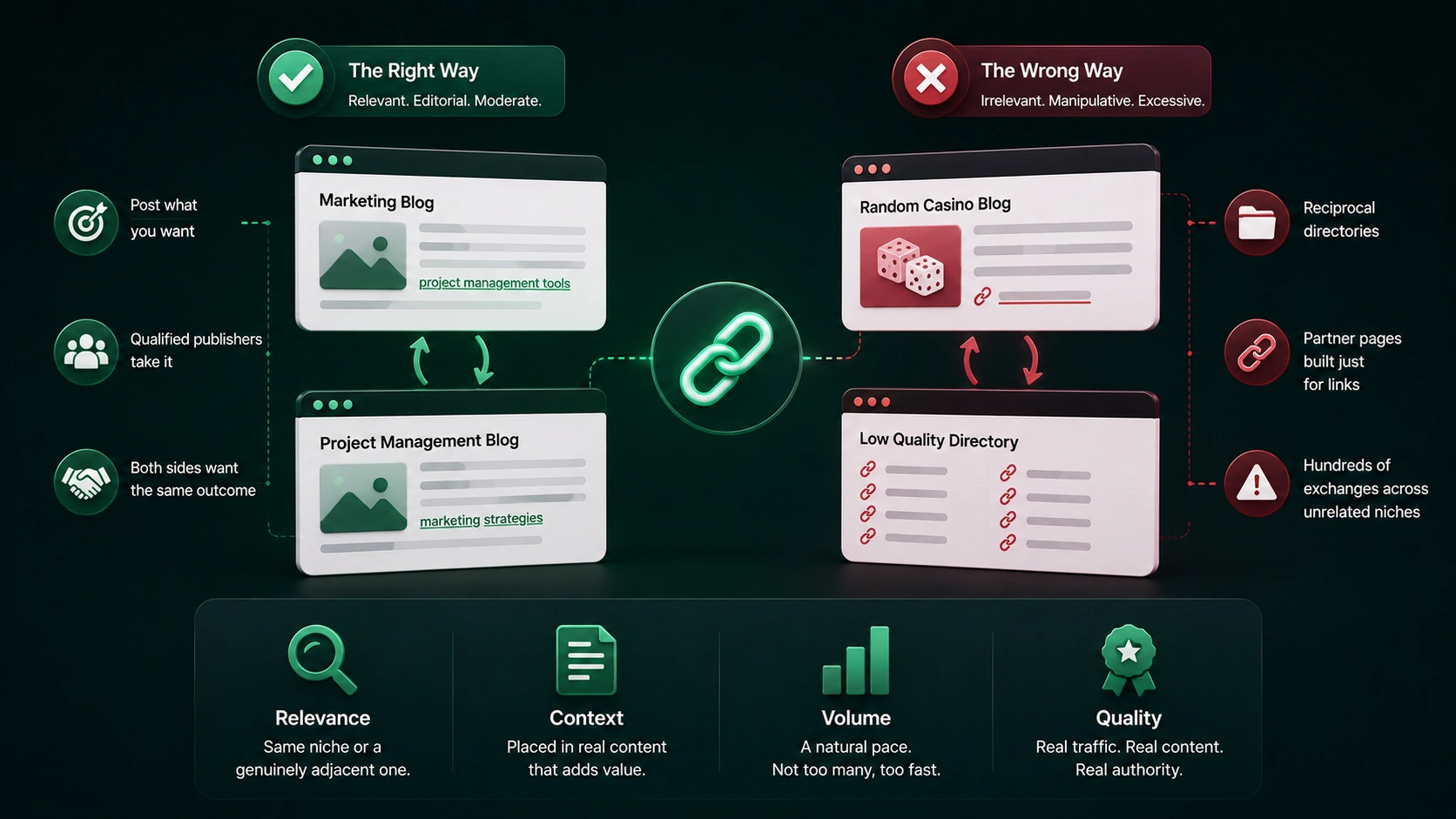
Link exchange. Sites in related niches link to each other’s content, editorially, in real articles. It does not have to be a direct swap — on a marketplace you can post what you want and let any publisher who meets your criteria take it. For a beginner this is the most accessible route, because it removes the hardest part — persuading a stranger who gets nothing in return. Both parties want the same outcome before the conversation starts.
The version that gets people in trouble is the old one: reciprocal directories, partner pages built purely for cross-linking, hundreds of exchanges across unrelated industries. The version that works is relevant, editorial, and moderate. Same four rules as everything else — relevance, context, volume, quality.
How many backlinks do you actually need to rank a page?
There is no universal number, and anyone who gives you one is guessing.
The real answer is comparative. Look at the pages currently ranking for the term you want. Check how many referring domains they have, and what quality. That is your target — not a number from a blog post.
For most small sites in low-competition niches, the honest figure is smaller than you fear. Ten to twenty good, relevant referring domains will move pages that currently rank nowhere. Competitive commercial terms are a different sport entirely.
The mistake nobody warns you about: the links you lose without noticing
You will build links, feel good about it, and then lose a meaningful share of them without noticing.
Links disappear constantly. Sites get redesigned and the article your link was in gets consolidated. Content pruning deletes the page. Domains expire. Publishers quietly strip outbound links during an SEO cleanup. This is called link rot, and it is not an edge case — it is the default outcome for any link building effort without monitoring.
Six months after a productive quarter, a chunk of what you built is gone, and unless something is checking, you will not know which. Track every link you acquire from day one, even if that means a spreadsheet with three columns.
What to actually do in your first 30 days of link building
- Pick one page. Not your homepage. Pick the page with real commercial value — a service page, a product page, a strong guide. All your early effort points at that one URL.
- Find your benchmark. Look up the referring domain counts of the pages currently outranking you. Now you have a target instead of a vibe.
- Fix your internal links first. Route links from your strongest existing pages to the one you picked. This costs nothing, requires nobody’s permission, and is the only item on this list you can finish today.
- Claim the free ones. Industry directories, your local chamber of commerce, professional associations, supplier and partner sites, any organisation you already have a relationship with. These are unglamorous and they are also the fastest legitimate links you will ever get.
- Set your quality floor. Decide the minimum DR and relevance you will accept, in advance, in writing. Beginners abandon their standards the moment someone offers them something.
- Start exchanging. Post what you want — your target page, your niche, your DR floor — and let publishers who fit those criteria take the offer. Sites at a similar level to yours are the likeliest to say yes, because they need the same thing you do.
- Track everything. Every link, where it points, whether it is do-follow, and whether it is still live.
Do that for a month and you will have more usable links than most people manage in six, because you skipped the part where beginners send four hundred emails and get two replies.
Where a link building tool fits, and why it should not be your first step
Everything above is doable manually. It is just slow — finding relevant partners, checking their DR and outbound profile, agreeing terms, confirming placement, and then monitoring for removal, forever.
That is what Linkexchange automates. It runs inside your WordPress dashboard, matches you with sites in your niche at the DR level you set, handles the exchange through a credit system, and monitors every link you build so you find out when one comes down.
The plugin also includes internal linking free, and for a beginner that part matters more than the exchange side does. It reads across your articles and recommends which of them should link to each other — the cheapest ranking work available to you, and worth finishing before you chase a single external link.
But do not start with the tool. Start by understanding what makes a link worth having, because no software will save you from wanting the wrong links.
Get started free at linkexchange.ai — 500 credits, no card required. Exchange smarter. Rank higher.