

Cold email response rates have collapsed, paid links are a liability, and guest posting does not scale. Here is why niche-matched link exchange is the backlink strategy that still works, how to do it without triggering Google’s spam policies, and how Linkexchange runs the entire cycle from inside your WordPress dashboard.
Here is the part of link building nobody puts in the case study.
You build a prospect list. You find the contact email. You write the personalised opener, the one that mentions their recent post so it does not read like a template. You send a hundred of them. You follow up twice. And after all of that, you get a handful of replies, most of them asking for money, and maybe one or two links that were actually worth having.
That is not a strategy. That is a lottery ticket with admin work attached.
Meanwhile, the site owner on the other end of your email is running the exact same broken process. They need links too. They have a site in your niche, with real traffic and real authority, and they would happily link to you — if someone would just link back and stop making it complicated.
That gap, between two people who each have precisely what the other needs and no efficient way to find each other, is the entire reason we built Linkexchange.
What link exchange actually is, and why the tactic got a bad reputation
Link exchange is simple enough to explain in a sentence: sites in related niches link to each other’s content, editorially, inside real articles that real people read.
It does not have to be a direct swap. You can post what you want — target page, niche, DR floor — and let any publisher who fits those criteria take the offer. That matters more than it sounds: when links are matched on criteria rather than locked into mutual pairs, the symmetrical A-links-to-B-and-B-links-to-A pattern that makes bilateral swapping obvious at scale never forms in the first place.
That is it. No outreach sequence. No cold email. No paying for placement on a site you have never heard of and cannot vouch for.
The reason it carries a mixed reputation is that people did it badly for a decade. Reciprocal link directories. “Partner” pages that existed for no reason except cross-linking. Hundred-site link wheels spanning completely unrelated industries. Google’s link spam policies name excessive link exchanges specifically, and they are right to.
But the abuse of a method is not an argument against the method. Guest posting was abused into oblivion by content farms and it is still a legitimate tactic when done properly. The same logic applies here. The difference between a link exchange that compounds your authority and one that creates risk comes down to four variables:
- Relevance. The linking site sits in your niche or a genuinely adjacent one. A project management SaaS blog linking to a productivity blog makes sense to a reader and to a crawler. A project management SaaS linking to a casino affiliate site does not, and no amount of anchor text engineering fixes that.
- Context. The link lives inside a real article where it adds something for the reader — a reference, a data source, a deeper explanation of a concept mentioned in passing. Not stranded on a partner page in the footer.
- Volume. A handful of well-matched exchanges per month reads as normal publishing behaviour. Two hundred in a week reads as a scheme, because it is one. Link velocity matters, and natural profiles grow at a natural pace.
- Quality. You are exchanging with sites that have real traffic, real content, and authority worth passing. A link from a DR 40 site with 8,000 monthly visitors in your niche is worth more than fifty links from DR 5 blogs nobody reads.
Get those four right and you are doing what every publisher has done since the web began: linking to useful things and being linked to in return. That is not a loophole. That is how the link graph was designed to work.
Why link exchange beats cold outreach, paid placements, and guest posting in 2026
Against cold outreach. The response rates have collapsed and they are not coming back. Inboxes are saturated, spam filtering is more aggressive every year, and every SEO on the planet is sending a near-identical template built from the same three blog posts about outreach personalisation. You are competing for attention with a message the recipient has already deleted forty times this year.
More importantly, cold outreach requires you to persuade a stranger to do you a favour with nothing in it for them. Link exchange removes the persuasion step entirely, because both parties already want the same outcome before the conversation starts. You are not asking. You are matching.
Against buying placements from link sellers. This needs an honest distinction, because Linkexchange runs on credits and you can top those credits up with money. So let us be precise rather than pretending cash never enters the picture.
When you buy a link the traditional way, you are paying a site owner for a placement, and their business is selling placements. That means they sell to everyone. The site you just paid is also linking out to a payday loan comparison page, a crypto exchange, and two casinos, and every one of those transactions degrades the asset you bought into. The link you paid for in January sits on a weaker page by June, through no action of your own. Worse, sites that monetise outbound links get identified as sellers eventually, and when that happens the value of everything you bought from them drops at once. No warning, no recourse, and no version of this where you file a complaint.
The difference in a credit network is not on your side of the transaction. It is in what governs the supply.
A link seller has no constraint on volume — more placements is simply more revenue, so their outbound profile degrades in a straight line. A network can impose constraints that a private seller has no reason to: DR floors, outbound profile checks on both sides, relevance requirements, pacing, and continuous monitoring of what stays live. Most participants are also there primarily to build their own profile, which means their incentives point at a clean, relevant, moderate link profile — the same thing you want from a site pointing at yours.
That is a structural difference in the quality of what you end up with, not a claim that no money changes hands anywhere in the system.
The permanence question is different too. Bought placements are rented — stop paying and they come down, and prices climb as the seller learns what you tolerate. An exchange link sits on a page from a publisher who has their own reason to keep it there.
None of which makes this free. You give up a slot in your content and some outbound equity, and topping up credits costs money. Those are real costs. The argument is not that exchange is cheaper. It is that the link you end up with comes from a healthier site.
Against guest posting. Guest posting still works. The economics are just brutal. Pitch, wait, get accepted, write 1,500 words for someone else’s site, wait for edits, wait for publication. That is days of work for a single link. It has a real place in a strategy for high-authority targets you genuinely want to be published on. It does not scale, and anyone claiming otherwise is outsourcing the writing to someone producing content nobody will read.
Against digital PR. The best links in SEO still come from earned coverage, and nothing in this article changes that. But digital PR needs budget, a genuine news hook, and a team. It is a layer you add once the foundation exists. It is not the foundation.
Why running link exchanges by hand falls apart after about three weeks
Anyone who has tried to run link exchanges by hand hits the same wall, usually around week three.
Finding partners in your niche is slow. You are searching, checking, and shortlisting sites one at a time. Vetting quality means pulling DR, traffic estimates, and outbound link profiles individually — and the outbound profile is the one everyone skips, which is how people end up exchanging with a site that links to four hundred unrelated domains from a sidebar.
Then you have to actually agree terms. Which page links to which page. What anchor text. Whether the link is do-follow, because a no-follow exchange is a favour, not a trade. Then you place your side and wait to confirm they placed theirs, and sometimes they do not, and you have no mechanism to do anything about it.
And then the real problem starts: keeping track over time.
Links get removed during redesigns. Pages get consolidated. Articles get deleted in content pruning. Sites expire. Six months after a productive quarter of exchanges, a meaningful share of what you built is gone, you cannot say which, and the authority you thought you had accumulated quietly stopped existing. Link rot is not a rare edge case. It is the default outcome of any link building programme without monitoring.
None of this is an outreach problem. It is a logistics problem — matching, vetting, settlement, and monitoring. And logistics problems are exactly what software is for.
What the Linkexchange plugin does inside your WordPress dashboard
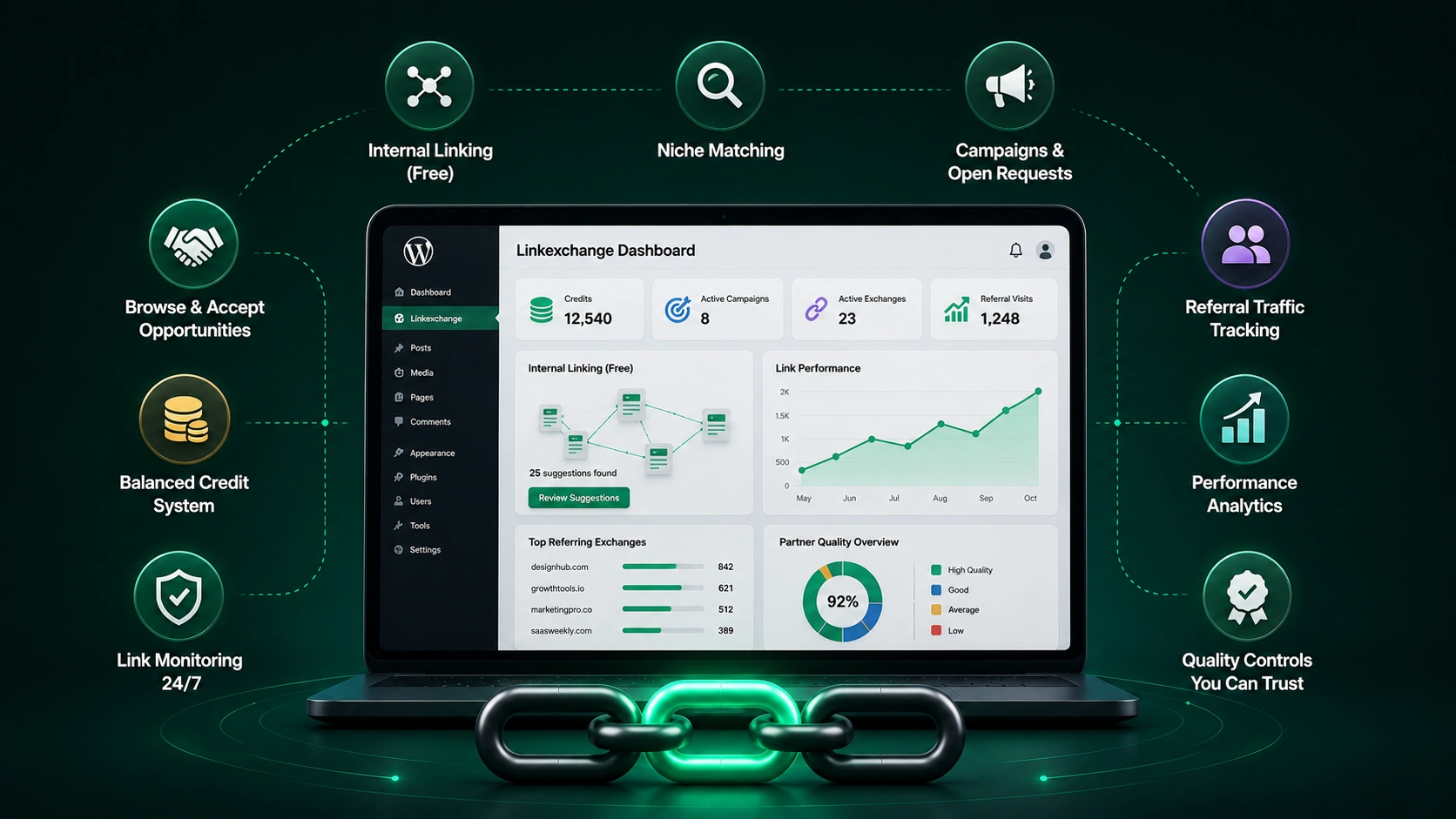
Linkexchange is a WordPress plugin and platform that runs the entire exchange cycle from inside your admin dashboard. You never leave WordPress and you never open a spreadsheet.
- Internal linking, free. The plugin reads across your articles and recommends internal links between the ones that genuinely relate to each other, so you can route authority around your own site without holding a fifty-post map in your head. This costs nothing and it is worth doing before any exchange.
- Niche matching. Tell it your niche and your target DR range. It surfaces partner sites that genuinely fit, instead of you assembling a prospect list by hand and hoping.
- Campaigns and open requests. Define what you want: which pages need links, what quality floor you will accept, how many exchanges you are targeting. Publishers who match your criteria can take the offer, so you are not waiting on one specific site to agree.
- Browse and accept. The reverse also works. You can search open requests and accept the ones that fit your own standards, which puts you in control of what appears on your site.
- A credit system. Credits keep the exchange balanced, so you are contributing as much value as you receive. This is what stops the marketplace degrading into a pile of people who want links and nobody willing to give them.
- Link monitoring. Every link you build is tracked continuously. When a partner’s link comes down, you find out — rather than discovering it during an audit a year later.
- Referral traffic tracking. You see which exchanges send actual human visitors, not just authority. A link that sends people is worth more than a link that only moves a number, and most tools never tell you the difference.
- Quality controls. DR visibility, do-follow verification, and outbound profile checks on partner sites before you commit to anything.
The point of all of it is to make the good version of link exchange — relevant, editorial, moderate, high quality — as easy as the bad version has always been.

Where to start: one campaign, one page, sixty days of evidence
Create a free account at linkexchange.ai, install the plugin, connect your site, and run one campaign. You get 500 starter credits without a card, which is enough to see whether the matching surfaces anything worth having in your niche.
Pick a single page you genuinely want to rank. A service page, a pillar guide, a product page — something with commercial value, not your homepage. Set a DR floor you are comfortable with. Choose a niche match rather than casting wide.
Then watch what happens to that one page over sixty days.
One completed exchange will tell you more about whether this fits your workflow than any article can, including this one. And unlike every cold email you have ever sent, the person on the other side is already saying yes before you start.
Get started free at linkexchange.ai — 500 credits, no card required. Exchange smarter. Rank higher.