

You published consistently for a year and traffic flattened anyway. Here is how to work out which ceiling you actually hit — content, technical, or authority — and why publishing more rarely fixes the third one.
There is a specific and demoralising point in a website’s life where the thing that was working stops working.
You published consistently. Traffic climbed. Then somewhere around month eight or ten it flattened, and it has stayed flat since — despite you publishing at the same rate, or faster. New posts get indexed and then sit there doing nothing. Your rankings hover on page two for anything with commercial value.
This is not a content problem, and the standard advice will not help you, because the standard advice is “publish more.” You are already doing that. It stopped working. That is the entire issue.
Three ceilings cap a website’s growth, and only one is fixed by publishing more
When a site plateaus, one of three things is capping it. They look identical from the outside and they need completely different responses, so diagnosing correctly is the whole game.
The content ceiling. You have not covered enough of your topic, or what you have covered is thin. Symptom: you rank for very few keywords overall, and the ones you do rank for are unrelated to each other. There are obvious subjects in your niche you simply have not written about.
Fix: publish more. This is the ceiling everyone assumes they have.
The technical ceiling. Pages are not being crawled, indexed, or served properly. Symptom: pages missing from the index entirely, slow load times, redirect loops, duplicate content, a sitemap that does not match reality. Traffic is not just flat but erratic.
Fix: audit and repair. Unglamorous, often dramatic in effect.
The authority ceiling. Your content is good, it is indexed, and it still cannot outrank the incumbents. Symptom, and this is the tell: you rank well for low-competition terms and nowhere for anything competitive. Positions 3–8 on long-tail queries, page three on anything a customer would actually search.
Fix: not publishing. You already produced the content and it is sitting on page three. What is missing is external evidence that your site deserves to be taken seriously.
How to confirm you have hit an authority ceiling, in about twenty minutes
This takes twenty minutes and it is worth doing before you spend another quarter writing.
- Pick five keywords you want and do not have. Not long-tail variants — the real commercial terms.
- For each, look at who ranks in the top five and check their referring domain counts, using Ahrefs, Moz, or any equivalent tool.
- Compare to yours.
If the pages beating you have three, five, ten times your referring domains, and their content is not obviously better than yours, you have an authority ceiling. No amount of additional publishing changes that arithmetic. You are bringing more content to a fight that is being decided on links.
The corollary is worth sitting with: if you have an authority ceiling, every article you publish from now on underperforms until you fix it. You are not just failing to grow. You are accumulating assets at a discount.

Why authority compounds, and why the same loop runs in reverse
Authority is not a linear input. It is a loop.
A site with authority ranks a new article faster. That article gets seen. Some fraction of the people who see it reference it — in a roundup, a resource list, a forum answer, their own blog. Those references are links, which raise authority, which makes the next article rank faster still.
That is the flywheel, and once it turns you get links without asking for them. The uncomfortable implication is that it also runs in reverse. A site without authority publishes into silence. Nobody sees the article, so nobody links to it, so the site gains no authority, so the next article publishes into the same silence. Most plateaued sites are stuck in the reverse loop, working hard, going nowhere.
Breaking out requires an external push. The flywheel does not start itself.
The free growth lever most plateaued sites never pull: internal linking
Before spending anything on external links, fix your internal ones. This is the highest-return work available to a plateaued site and it costs nothing but attention.
Internal links distribute authority around your own site. If you have earned links to your homepage or one popular post, that value can be routed to the pages you actually want to rank — if the paths exist.
Most sites have terrible internal linking. Old posts nobody links to from anywhere. New posts that link out to sources but never sideways to related content. Money pages with fewer internal links pointing at them than a three-year-old blog post about industry news.
- Map which of your pages have the most external links pointing at them.
- Route internal links from those pages to your commercial targets.
- Build topic clusters — a pillar page on your core subject, with supporting articles linking up to it and to each other.
- Use descriptive anchor text internally. There is no over-optimisation risk on your own site the way there is externally.
Do this across a fifty-post blog and you will usually see movement within weeks, before a single new external link exists.
The catch is that doing it by hand across fifty posts is genuinely tedious — you are holding a mental map of which pages have equity, which pages need it, and which of your older articles could plausibly link to which. It is the kind of work that gets started and abandoned.
The Linkexchange plugin includes internal linking free. It reads across your existing articles and recommends links between the ones that actually relate to each other, so the mapping work is done for you. You can use this without touching the exchange side at all — and if you are only going to act on one thing in this article, make it this one.
Then comes the external push: earning referring domains without a budget
Once internal structure is sound, you need referring domains. The realistic options for a site without budget or a PR team come down to a few:
Cold outreach works eventually but poorly, especially from a site with no reputation yet — you are asking strangers for a favour with nothing to offer. Guest posting works and does not scale, since it costs days of work per link. Digital PR produces the best links and needs budget and a news hook.
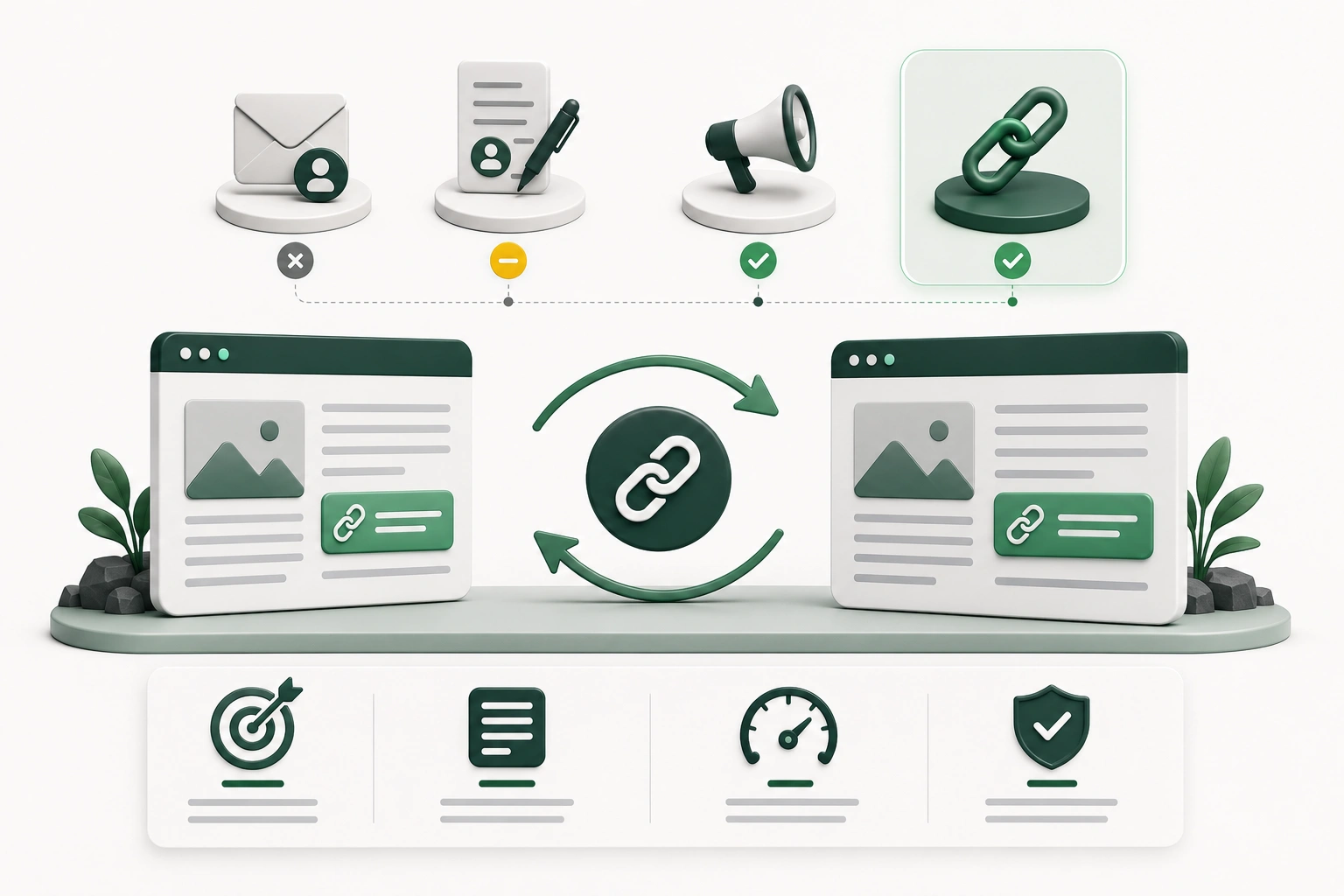
Link exchange is the one most available to a plateaued site, because it removes the persuasion problem entirely. Sites in related niches link to each other’s content, editorially, inside real articles. It does not have to be a direct swap — post your target page, niche and DR floor, and let any publisher who fits take the offer. The other party is not doing you a favour: they need the same thing you do, and sites at a similar level are the most likely to agree, because you are actually useful to each other.
The rules that keep it working are the same ones that govern everything else: relevance to your niche or an adjacent one, links placed in genuine content rather than a partner page, a moderate pace that looks like normal publishing, and partners with real traffic and clean outbound profiles.
What realistic growth actually looks like, month by month
Expectations kill more link building programmes than bad execution does.
Weeks 1–4. Internal linking fixes land. Some movement on pages that were already close. First external links go live. Nothing dramatic.
Months 2–3. New referring domains begin registering. Pages sitting at positions 11–20 start crossing onto page one — that band moves first, because it needs the least push. This is where you see the earliest honest signal.
Months 4–6. Compounding starts. Rankings improve on pages you have not touched, because sitewide authority rose. Competitive terms become reachable rather than theoretical.
Months 6–12. The flywheel turns. Natural links arrive without being asked for. New content ranks faster than old content did.
Anyone promising you month-one results on competitive terms is either selling something or about to get your site penalised.
The reason the timeline stretches this far is that search engines are deliberately slow to re-evaluate. A link needs to be discovered, crawled, and then weighed against everything else pointing at that page, and none of those steps happen on your schedule. Sites that give up at week six almost always quit during the phase where the work has been done and simply has not registered yet.
Measure the right things: referring domains, positions, referral traffic, survival
Domain Rating is a proxy, not a goal. It is a third-party estimate, and optimising for it directly leads people to acquire links that raise a number without moving a business.
Track these instead:
- Referring domains, not total backlinks. Fifty links from one site is one vote.
- Keyword positions on your five commercial targets. This is what you are actually buying.
- Referral traffic per link. A link that sends real visitors is worth more than one that only passes authority, and it is the cleanest evidence that a partner site is real.
- Link survival rate. How many of the links you built six months ago are still live. If nobody is checking, the answer is lower than you think — link rot is the default, not an edge case.
Set a baseline for all four today, before you change anything. A plateaued site that starts work without recording where it started cannot tell in three months whether the work did anything, which is how programmes get abandoned for the wrong reasons.
Where a link exchange tool fits into breaking an authority ceiling
All of this is manual work: finding relevant partners, checking their DR and outbound profile, agreeing placements, confirming both sides delivered, and monitoring indefinitely for removals.
Linkexchange handles that cycle from inside your WordPress dashboard — niche matching at the DR floor you set, exchange settlement through credits, referral traffic attribution per link, and continuous monitoring so a removed link surfaces immediately instead of during an audit next year.
It does not fix a content ceiling and it will not repair a technical one. If you diagnosed an authority ceiling, though, it is the fastest route through it that does not require a budget or a press contact.
Get started free at linkexchange.ai — 500 credits, no card required. Exchange smarter. Rank higher.