

AI systems do not cite pages. They lift passages. That single fact changes what a well-structured article looks like, and most of the changes cost nothing but editorial discipline. Figures current as of August 2026. This area moves quickly — treat everything below as directional and check the sources before quoting.
Traditional SEO optimised the page. You wrote comprehensively, structured it sensibly, and the whole document competed for a position. Extraction works differently. A system reading your article is looking for a block of text it can lift, quote, and attribute — a self-contained unit that answers one question without requiring the surrounding narrative to make sense. That means a page can be excellent, comprehensive, well-linked, and entirely unusable, because nothing in it can be removed from its context without breaking.
The unit that gets cited
Think in blocks rather than in articles. A citable block is a passage that survives being cut out and pasted somewhere else. It states its own claim, contains its own evidence, and does not depend on the preceding two paragraphs to be intelligible. Most writing fails this by default, and not because it is bad writing. Good prose builds — each paragraph leans on the last. That is exactly the property that makes it unextractable. The fix is not to write badly. It is to make sure each major section opens with something that stands alone, then develops normally after that. Authority still puts you in the candidate pool — the how to get backlinks ranking covers how that gets built — but structure decides whether anything is picked out of it.
The answer capsule
The highest-return single change: open every major section with a 40 to 60 word paragraph that answers the section’s question directly. Systems extract these close to verbatim. The structure:
- First sentence states the answer. Not context, not scene-setting, not “in today’s competitive landscape”
- Next two or three supply the mechanism or the number
- Then expand at whatever length the topic warrants
The discipline is removing throat-clearing. Most articles spend their first paragraph explaining why the topic matters — which is preamble a system skips, and which readers skip too. Multiple capsules per page, one under each heading, because an overview assembles from several sources answering several sub-questions rather than one source answering one.
Definitive language, which is the finding most people ignore
Analyses report that cited text is nearly twice as likely to contain definitive statements as hedged ones — one figure puts it at around 36% against 20%. This is the most actionable and least acted-on finding in the area, because hedging is a habit rather than a decision. Unquotable: “Results may vary considerably depending on a number of factors, and it is generally advisable to consider your specific circumstances.” Quotable: “Sites under 50 referring domains typically see movement within six to eight weeks. Above that, expect three months.” The second commits to something. It can be wrong, which is precisely why it is useful — an extraction system cannot lift a claim that has been carefully arranged to say nothing. Practical edit: search your draft for “may,” “can,” “often,” “generally,” “it depends,” and “in some cases.” Each one is a decision point. Either commit to the claim or cut the sentence. Keep the hedges where the uncertainty is real and material, which is rarer than most drafts assume.
Specific, attributed, verifiable
“Most businesses see improved results” is not extractable. It has no number, no source, and nothing that could be checked. “Adding statistics increased AI visibility by 22% in the Digital Bloom analysis” is extractable. A number, a magnitude, and a named source. Reported effects here are substantial: adding statistics raises AI visibility by around 22% and quotations by around 37%, with content containing original statistics reported at 30 to 40% higher visibility. Three practical consequences: Attribute everything. Name the source in the text, not just in a link. A system lifting your sentence carries the attribution with it, which makes the passage more trustworthy in isolation. Use numbers wherever honest. Not invented precision — real figures, ranges, or counts. “Three to five” beats “several.” Original data is disproportionately valuable. A statistic nobody else has published cannot be sourced from a competitor’s page, which makes yours the only citable option. If your product generates data, that is your strongest asset for this and for links alike.

A before and after
The same section, written two ways. This is what the difference looks like in practice. Before:
When it comes to building links, there are a number of factors that site owners should take into consideration. The landscape has changed considerably in recent years, and what worked previously may no longer deliver the same results. It is generally advisable to think carefully about your approach before committing significant resources. Many practitioners have found that a more measured strategy can often yield better outcomes over time, though of course individual results will vary depending on your particular circumstances and niche.
Ninety words. No claim, no number, no source, nothing extractable. A system reading this has nothing to lift. After:
Link acquisition rates between 5% and 15% of your existing referring domain count per month are unremarkable for most sites. A site with 40 referring domains can absorb 2 to 6 new ones monthly without the pattern looking unusual. Above that band, the shape of the curve matters more than the number — discontinuous acquisition is a stronger signal than fast acquisition.
Sixty words. Three claims, two numbers, a stated mechanism. Every sentence can be lifted independently and still make sense. Note what did not change: the second version is not shorter overall, not less nuanced, and not written in bullet points. It commits to specifics where the first version gestured at them.
Headings that state claims
A heading is a boundary marker for extraction. It tells a system where a block starts and what it contains. Weak: “Considerations” · “Best Practices” · “Getting Started” Strong: “Why exact-match anchors are the risky ones” · “How to audit a link partner in five minutes” · “What a defensible anchor distribution looks like” The strong versions state their own claim or name their own deliverable. They also survive being read in isolation in a table of contents, which is a reasonable proxy for whether an extraction system can categorise the block beneath them. Question-form headings work particularly well where the search intent is a question, because they match the query almost literally. If your existing pages are full of one-word headings, that is a cheap fix across an archive — and a symptom of the wider content-structure problem the SEO plateau guide covers. Keep the hierarchy clean: one H1, logical H2s, H3s nested under them. Do not use heading tags for visual styling — a bold line that looks like a heading and is not tagged as one is invisible to the structure.
Structuring for sub-questions
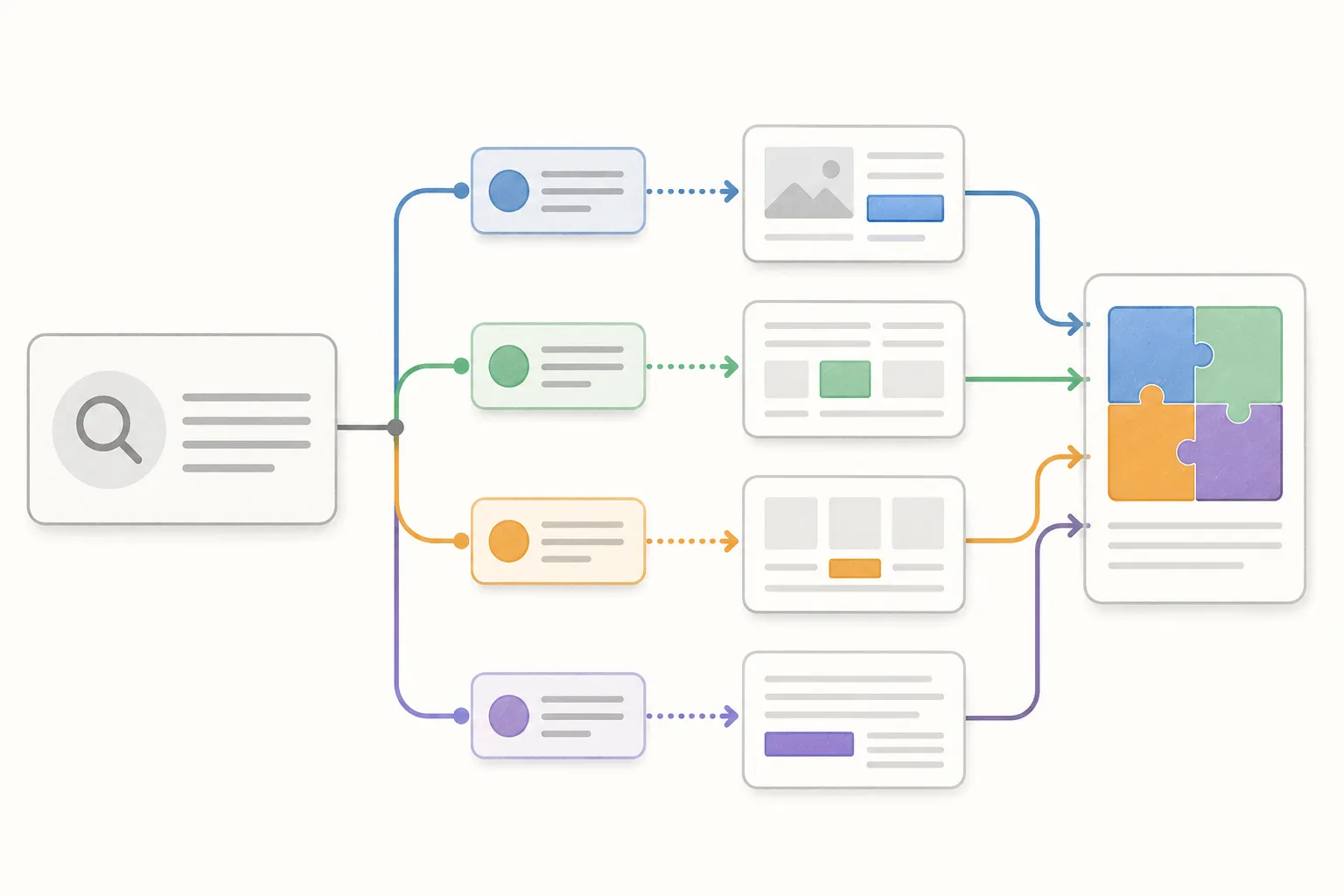
Google decomposes a query into sub-questions and assembles the answer from sources addressing each. Ranking for those sub-queries reportedly raises citation odds substantially — one analysis puts the lift at 161%. The practical implication: a page answering one head term comprehensively in flowing prose is worse positioned than a page addressing six named sub-questions under clear headings. To find them, type your head term into Google and expand the People Also Ask box two levels. Those are the decomposed questions. Each deserves a heading and a capsule.
Formats that extract cleanly
Consistently reported as favoured: numbered step-by-step processes, definitions, structured comparisons, lists, tables, and data-backed positions. The shared property is a clear boundary. A table row or a numbered step can be lifted without understanding the surrounding argument. A 400-word paragraph making the same point has no unit inside it. This does not mean converting every article into bullet points. It means that where content is genuinely list-shaped, comparison-shaped, or process-shaped, formatting it that way costs nothing and makes it usable.
Schema, and what it actually does
No markup forces a citation. What it does is remove ambiguity about what a block contains.
- FAQPage on genuine question-and-answer sections — states explicitly which text is the question and which is the answer
- Article with a named author, real bio, and accurate dates
- HowTo on step-by-step processes
- Organization with naming consistent across your site and every external profile
Only mark up what actually exists. FAQ schema on a section that is not a genuine FAQ is a structured data violation and gets flagged.
Freshness as a structural requirement
Content under 90 days old is reported to be cited more often, with a measurable decay after that. The practical response is not more publishing. It is quarterly maintenance on your best pages: update statistics, add a section covering a sub-question you missed, correct anything that has changed, update the date honestly, and request reindexing. Updating a page that already holds authority is consistently faster than ranking a new one. Which raises the question the instruction skips: which pages are your best ones? Most people answer by traffic, and traffic is the wrong measure here. The page worth restructuring is the one holding external authority, because that is the one already in the candidate pool. Those are frequently not the same page, and almost nobody checks. Linkexchange answers it free. Authority flow shows which of your pages actually hold earned links and where that authority currently goes. Money pages shows which of your priority pages are receiving nothing. That gives you the refresh list in the right order — start with the pages that already have standing, not the ones that happen to get visits. Cluster analysis covers the other half of this article. The fan-out section above argues for six named sub-questions under clear headings; cluster analysis groups your existing articles by topic, flags which clusters have no pillar, and lists the connections missing between them. Same structure, built from pages you have already written.
Where this goes wrong
Writing for extraction at the expense of readers. A page of disconnected capsules with no argument is worse for humans and does not obviously help machines either, since coherence is part of how quality is assessed. Manufacturing false confidence. Definitive language is valuable when the claim is defensible. Stating things confidently that you do not know is how you end up cited being wrong, which is worse than not being cited. Over-formatting. Converting genuine argument into bullet fragments loses the reasoning that made it worth citing. Treating this as a replacement for authority. Structure determines whether you are picked from the pool. Something still has to put you in it, which is why the AI Overviews backlinks analysis treats structure and authority as complements rather than alternatives. The honest summary: this is editorial discipline rather than a discipline of its own. Answer first, commit to claims, attribute specifics, mark boundaries clearly, and keep it current. Every one of those was good writing advice before any of this existed.