

GEO, AEO, LLMO, AI SEO — four labels for substantially the same work, sold as four disciplines. Here is what each term actually means, what genuinely differs from SEO, and how to tell a real practitioner from someone who renamed their existing service. Terminology current as of August 2026. The labels in this space are unstable and several will not survive the year.
A new vocabulary arrived faster than the practice it describes. If you have been offered GEO services, or seen AEO added to an agency’s homepage, it is worth knowing what the words mean before deciding whether the thing behind them is new. Some of it is genuinely new. Most of it is SEO with different emphasis, which is not an insult — the emphasis has genuinely shifted.
The terms, defined
SEO — search engine optimisation. Making pages rank in traditional search results. The original discipline, and the one everything else is defined against.
AEO — answer engine optimisation. Optimising to be the answer rather than a result. Predates the current wave — it grew out of featured snippet and voice search work — and now covers being extracted into AI-generated answers.
GEO — generative engine optimisation. Optimising for visibility inside AI-generated responses across ChatGPT, Gemini, Perplexity, Claude, and AI Overviews. The term originates from academic work on how generative systems select and cite sources, which is why it has slightly more claim to being a distinct field than the others.
LLMO — large language model optimisation. The same thing as GEO with a different noun. Used interchangeably.
AI SEO. The vaguest of the set, and frequently used to mean “using AI to do SEO” rather than “optimising for AI,” which are unrelated activities. Ask which is meant. The honest position:
AEO and GEO describe a real shift in emphasis. They do not describe a separate discipline with separate fundamentals.
What genuinely differs from traditional SEO
Four things, and they are real.
1. The unit is the passage, not the page. Traditional SEO optimised a document to compete for a position. Extraction lifts a block of text that can stand alone. A page can rank well and be entirely unusable because nothing in it survives removal from context — a distinct problem from the content and authority ceilings covered in the SEO plateau guide, and one that can coexist with either.
2. Ranking no longer gates citation. The share of AI Overview citations coming from top-ten pages has fallen sharply — one large 2026 study puts it at 38%, down from around 76% seven months earlier. Pages that cannot realistically reach position one can still be cited.
3. Entity recognition became a direct input. Systems assess whether what a brand says about itself aligns with what other sources say. That makes unlinked mentions and brand consistency load-bearing in a way they were not — covered in the generative engine optimisation analysis.
4. Multiple engines, different indexes. ChatGPT, Gemini, Perplexity and AI Overviews draw on different sources. Optimising for one does not automatically cover the others, and some of them lean heavily on places most SEO strategies ignore entirely.
What is identical, despite the branding
Every credible piece of GEO advice reduces to things that were already good practice.
- Answer the question early and clearly. This was featured snippet advice in 2016
- Use clean heading hierarchy. This was accessibility and readability advice before it was anything else
- Cite sources and use specific numbers. This was editorial standards
- Demonstrate genuine expertise. This is E-E-A-T, which predates the current wave by years
- Keep content current. Freshness has been a ranking consideration for a long time
- Use structured data. Schema.org launched in 2011
- Build authority so you are in the candidate pool. This is link building, unchanged
That list is most of what any GEO service delivers. The reframing is useful — it makes the case for editorial discipline that people previously ignored — but the work is not new.
How to tell a real practitioner from a rebrand
Five questions. The answers separate substance from vocabulary.
“What do you measure, and how?” AI visibility is genuinely hard to measure. Search Console does not break out AI Overview impressions. Anyone claiming precise citation-rate reporting should explain the methodology, which usually turns out to be manual sampling. Manual sampling is a legitimate answer. A dashboard with no explanation is not.
“Which engines, and how do your tactics differ across them?” If the answer treats ChatGPT, Perplexity and AI Overviews as one target, they are describing generic advice.
“What is different from what an SEO would have done in 2023?” A good answer names the passage-level shift, entity consensus, and the ranking-citation decoupling. A weak answer restates general SEO. “What are the limits?” Anyone who cannot name what this does not do is selling rather than advising.
“How do you handle authority?” If the answer is that authority no longer matters, they have misread the research. Rankings still gate the candidate pool, and the correlation between first-page position and citation remains the strongest single finding in the area — which is why the how to get backlinks ranking has not become obsolete.
What to actually do, without buying anything
The work behind these labels is available to you directly and mostly costs editorial time.
- Pick your five highest-traffic informational pages. Fastest wins come from upgrading pages that already have authority, not from new ones
- Add answer capsules. Forty to sixty words at the top of each page and under each major heading, stating the answer first
- Remove the hedging. Cited text is reported as nearly twice as likely to contain definitive language. Commit to claims or cut the sentences
- Add specifics with named sources. Numbers and attributions, in the text rather than only in links
- Add sub-question headings pulled from People Also Ask, since queries get decomposed and each sub-answer is a separate citation opportunity
- Fix entity consistency. Identical business name, description, and category across your site, LinkedIn, and every profile
- Add FAQPage schema where genuine questions exist. Only where they genuinely exist
- Set a quarterly refresh on those five pages
That is the substance. It does not require a new vendor, a new tool category, or a new budget line.
One correction to step one. “Highest-traffic” is the wrong sort order, and it is the one everyone uses. The pages worth upgrading first are the ones holding external authority, because those are already in the candidate pool. Traffic and authority frequently sit on different pages, and nothing in Search Console tells you which is which at a glance. Linkexchange gives you that sort order free. Authority flow shows which of your pages hold earned links and where the authority goes from there. Money pages shows which of your priority pages receive nothing. Cluster analysis groups your existing articles by topic and flags which need a pillar — which is step five above, done from the pages you already have rather than from a People Also Ask box. Step six is worth pairing with it. Entity consistency is about your name and description matching across profiles; structural coherence is whether your site reads as authoritative on a subject rather than as scattered posts. Both feed the same assessment, and only one of them is usually being worked on.
The engines, and where they actually differ
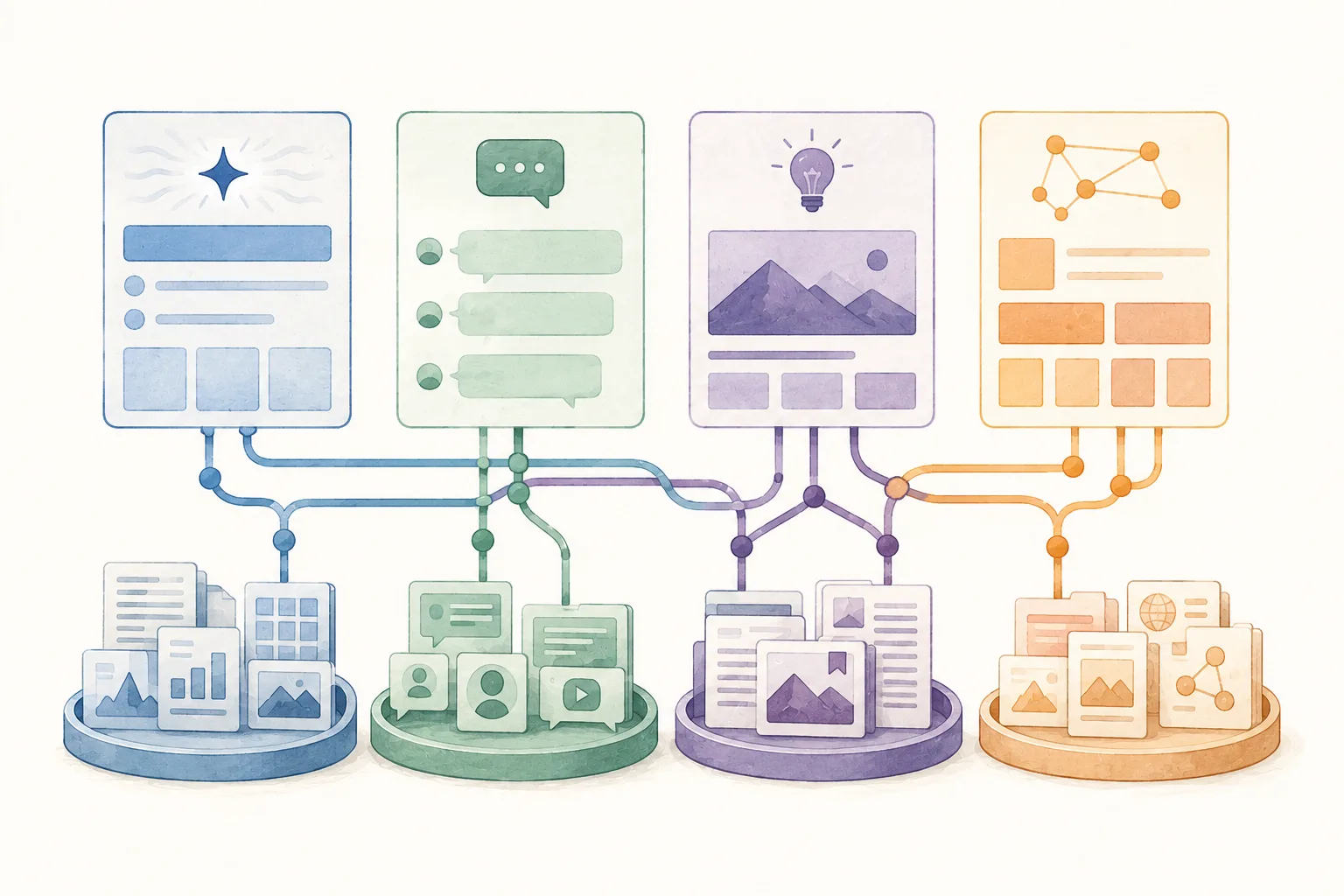
The most common weakness in advice under these labels is treating every AI surface as one target. They draw on different indexes and reward different things.
Google AI Overviews. Draws heavily on Google’s own index, so traditional ranking still matters most here even after the decoupling. YouTube is reported as the most-cited domain within Overviews specifically, which is a distinctive feature of this engine rather than a general rule.
ChatGPT. Uses Bing as its search layer, which means Bing visibility is a separate concern most SEO strategies never address. Worth checking whether you rank in Bing at all — for many sites the answer differs sharply from Google.
Perplexity. Cites more sources per answer than most engines and links them prominently, which makes it comparatively generous with referral traffic. Also the easiest to test manually.
Gemini. Google’s index again, with different assembly behaviour from AI Overviews.
Across all of them, cross-platform citation analysis puts Reddit as the most-cited domain overall — which is uncomfortable for any strategy built entirely around your own blog, and is the clearest argument for treating community presence as a separate workstream. The practical consequence: if a vendor’s tactics do not change across these, they are describing generic content advice with an acronym attached.
The measurement problem nobody has solved
Worth being direct, because this is where the category is weakest. There is no equivalent of rank tracking for AI citation. Search Console folds AI Overview impressions into standard reporting rather than isolating them. Third-party tools sample rather than measure, and their coverage of ChatGPT and Perplexity is partial. What is actually available:
- Manual sampling. Twenty queries, incognito, monthly, recording which domains get cited. Tedious and honest
- The impressions-versus-clicks pattern. Impressions steady while clicks fall is the signature of being seen inside an answer rather than clicked through
- Branded search volume. If citation is working, more people encounter your name and some search for it directly afterwards
- AI referral traffic. ChatGPT, Perplexity and others appear as distinct referrers in analytics. Small numbers for most sites, but real rather than inferred
Anyone selling precise measurement is either using one of these and describing it grandly, or has not thought about it.
Whether any of this matters for your site
Depends on one thing: how much of your traffic comes from informational queries. AI Overviews appear on roughly 48% of Google queries as of early 2026, with reported concentration up to 88% in healthcare, 83% in education, and 82% in B2B technology. Around 88% of triggers are informational-intent queries. If your traffic is transactional, local, or navigational, the exposure is materially lower and the urgency is correspondingly less. If your traffic comes from guides, explanations and comparisons in a technical or professional sector, this is already affecting you and the structural work is worth doing now. Either way, the label you use for it is the least important part. Answer first, commit to claims, attribute specifics, keep it current, and stay in the candidate pool. That was good advice before anyone needed an acronym for it.