

Guest posting still produces good links. It also costs roughly eight hours each once you count the pitches that fail, and the sites that accept anyone are precisely the ones not worth appearing on. Here is where it still earns its place.
Guest posting has been declared dead more often than any other link building tactic, and it keeps not being dead. What actually happened is narrower and more useful to understand: the volume version stopped working, the targeted version never stopped, and most of the advice conflates them.
What Google actually says about it
Worth being precise, because this is where the confusion starts. Google’s link spam policies do not prohibit guest posting. What they name is large-scale article campaigns where the primary purpose is link acquisition rather than reader value — the phrase used covers guest posting and syndication campaigns using keyword-rich anchor text at scale. The distinguishing variable is intent and scale, not the format. A contributed article on a publication with editorial standards, written because you have something to say, is not what the policy targets. Four hundred articles placed across sites that publish anything is exactly what it targets. The practical test:
would this piece have been commissioned if it carried no link? If yes, you are contributing. If no, you are placing.
The real cost per link
Most people cost this by counting the article they wrote. That misses most of it. Assume a 15% pitch acceptance rate, which is optimistic without an established name. To land one placement you send roughly seven pitches.
- Prospect research and personalisation — 20 minutes each across seven pitches: about 2.3 hours
- Follow-ups — roughly 30 minutes
- Writing the accepted piece properly, at 1,200 to 2,000 words: 4 to 6 hours
- Edits and coordination — about an hour
Total: roughly 8 hours per acquired link. At a modest $50/hour internal rate that is $400 in time. Outsourcing the writing does not fix it. Competent 1,500-word pieces run $150 to $400, you still do the pitching, and outsourced writing that reads as outsourced gets rejected by the publications worth appearing on — or accepted by the ones that are not. If you pay for placement instead, 2026 pricing puts transacted guest posts somewhere between roughly $164 and $459 on average, with quality-band placements on DR 50+ sites running $600 to $1,200. Those figures and why the published studies disagree so widely are covered in the guest posting for links pricing breakdown.
The quality problem underneath the numbers
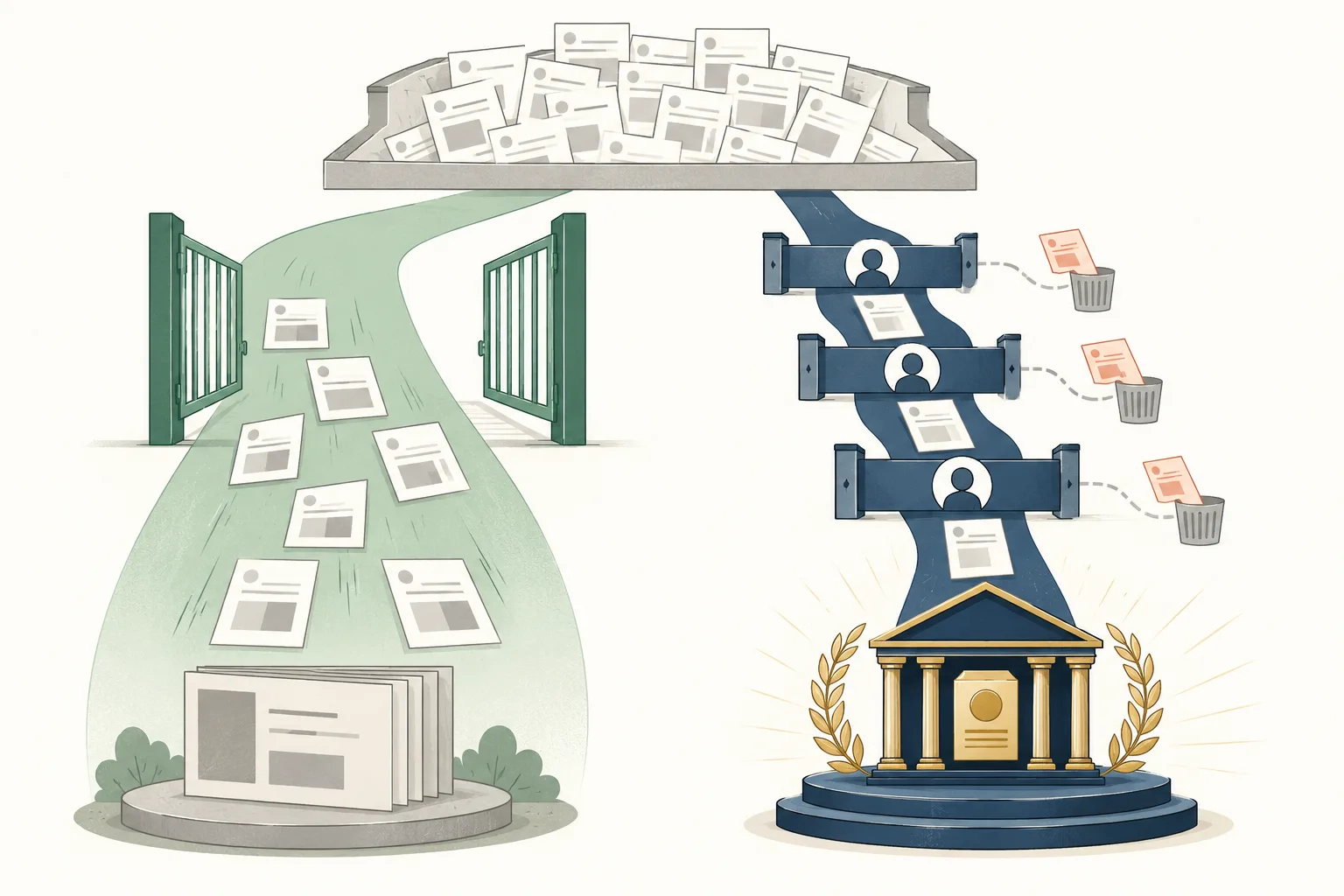
Here is what makes the real cost worse than it looks. Analyses of guest post opportunity quality are consistently bleak: a large majority of sites accepting contributions fall below DR 40 with minimal traffic, and only a small fraction meet a standard most SEOs would defend. That inverts the naive calculation. If only one placement in ten meets a bar you would actually stand behind, your real cost per usable link is ten times the headline figure. The cheap tier is not a cheaper version of the same thing — it is a different product sold under the same name. There is also a selection problem that no amount of filtering solves.
Sites that accept contributions readily are, by definition, sites that accept contributions readily. A publication with genuine editorial standards is hard to get into precisely because it is worth getting into, and the ease of acceptance is inversely correlated with the value of the placement.
Where it still clearly works
Four situations, and they share a property: the link is not the main reason.
Publications you genuinely want to appear on. Two or three a year, where the byline carries weight with your actual audience. The link is a side effect of a credibility placement.
Reaching an audience you cannot otherwise reach. If the publication’s readers are your buyers, the referral traffic and the positioning can justify the eight hours regardless of the link.
Building E-E-A-T signals. Named authorship on respected publications supports the credibility of everything else you publish, which matters for how your own site is assessed.
You have something genuinely worth saying. Original data, an unusual case, a position nobody else is taking. Editors accept these because the piece is good, which is also why it lands somewhere worth landing.
Where it clearly does not
As a volume tactic. Eight hours per link does not scale. Ten links is ten times the work, which makes it a project rather than an engine. Every mix needs one tactic where effort does not rise linearly with output — the guest posting for links ranking covers which candidates fill that slot.
For a site with no credibility yet. Pitching without a name, a portfolio, or a distinctive angle produces acceptance rates near zero at good publications and acceptance at bad ones. That is the worst of both outcomes.
When you cannot write. Or cannot afford to. Guest posting is effectively closed at any quality worth having.
On sites that publish everything. Write-for-us pages listing prices, forty contributed articles a month, no visible editorial process. The placement is worth little and the association is worth less.
The version that costs nothing, and nobody runs
Before spending eight hours writing 1,500 words for someone else’s site, there is a question worth asking: are the pages on your own site that already rank getting the internal support they need? The comparison is stark. A guest post is a new page on a domain you do not control, starting from zero traffic and zero authority, that took a day to produce. An existing page on your own site may already hold external links and rankings while passing none of that value onward, because nothing internal points to your commercial pages. Routing that authority properly is an afternoon, requires nobody’s approval, and frequently moves rankings faster than an external link does — because there is no acquisition delay, only recrawling. The link exchange guide covers where external acquisition genuinely becomes the constraint, which is later than most people assume. None of that replaces guest posting for the targets where the byline matters. It does mean the eight hours has an opportunity cost, and the alternative use of those hours is usually undervalued.
Finding targets worth pitching
The prospecting problem in guest posting is not finding sites that accept contributions. Those are trivial to find, and the article above explains why that is precisely the problem — a site easy to get into is easy for everyone. The real problem is finding the small share worth eight hours. That means checking each candidate on the things that actually decide the placement’s value: real traffic rather than authority alone, a clean outbound profile, an editorial process, and topical fit close enough that a reader would expect the link. Doing that by hand is the expensive half of the tactic, and it is where most people give up and lower the bar instead. Linkexchange surfaces guest post opportunities filtered on those criteria rather than on willingness to publish. You set the floor — niche and adjacency, minimum DR, minimum traffic — and the sites that come back are the ones that clear it, which is a much shorter list than a directory of write-for-us pages and a much more useful one.
It does not write the article and it does not lower the bar for you. Eight hours is still eight hours, and a site that clears the filter can still be wrong for you — minute one of any partner check is reading two of their pieces and deciding whether a person wrote them for a reason. What it removes is the qualification work, which is the part that scales badly and gets skipped.
How to pitch, if you are going to
The pitch matters less than target selection, but it still fails in predictable ways.
- Read the publication first. Not the write-for-us page — three recent articles. Pitching a topic they covered last month is the most common instant rejection
- Pitch an angle, not a topic. “Link building” is a topic. “Why our 200-site test found the opposite of the standard advice” is an angle
- Lead with what you have that others do not. Data, access, an unusual position. This is the entire argument for accepting you
- Keep it under 150 words. Editors decide fast
- Name a specific slot. Reference the section or series it would fit
- One follow-up after a week. Then move on
Do not mention SEO, do not mention links, and do not send the finished article unsolicited unless the guidelines ask for it.
The details that decide what the link is worth
Agree these before you write, because after publication you have no leverage.
Body link or author bio? A link inside the article carries considerably more than one in a bio block, and bio links are frequently nofollow. Ask directly.
Do-follow? Some publications nofollow all contributor links as policy. Worth knowing before you spend six hours writing.
How many links, and to where? One contextual link to a genuinely relevant page beats three to your homepage and a service page.
Anchor text? Branded or descriptive. Requesting exact-match commercial anchors on a contributed piece is the pattern that made editors suspicious of guest posts in the first place.
Will it stay up? Publications prune archives. Log the placement and check periodically, because a guest post that disappears took eight hours with it.

A realistic annual plan
If guest posting belongs in your mix at all, this is roughly what it should look like.
Pick three targets for the year. Publications where the byline genuinely matters to your audience — not the three highest DR sites that accept contributions. Write them down in January.
Build the case for each before pitching. Read six months of their output. Identify what they have not covered that you can cover with something they cannot get elsewhere. This is the work that determines acceptance, and it happens before any email.
Budget a full day per placement. Pitching, writing, edits. Three placements is three days across a year, which is manageable. Thirty would not be.
Sequence them. One accepted piece on a recognised publication materially improves your acceptance odds at the next. Start with the most reachable of your three and use it as evidence.
Do not fill the gaps with lesser targets. The temptation after two rejections is to lower the bar until something accepts. That is how people end up with contributed articles on sites nobody reads, which is worse than having none. Three good placements a year is a genuinely useful outcome. Thirty mediocre ones is a liability that took ten times the effort.
What replaced it for volume
If guest posting was your main channel and is producing little, the diagnosis is usually that you were running the volume version of a tactic that only works targeted. The replacement is not a better pitch. It is a different structure: tactics where the persuasion step is absent, or where effort does not scale with output. Mentions you already have. Relationships that predate the request. Assets worth citing without being asked. Or a marketplace, which is the only one of those that runs weekly. Linkexchange works from inside your WordPress dashboard: you post the target page, niche and minimum DR, and publishers meeting those criteria take the offer. No pitch, no acceptance rate, no 1,500 words written for someone else’s site. The cost comparison is the whole argument. Guest posting is eight hours and one link, most of it spent on pitches that fail. Here the effort is spent once when you set the criteria, and the price per placement is an outbound link slot on a page you already own rather than a day of writing. The links are not the same links. A contributed piece on a publication you genuinely wanted is worth more than any exchange placement, and this article has spent 1,500 words saying so. What it is not is repeatable — which is the reason it cannot be your engine.
Run both, for what each is good at. Keep guest posting for the two or three targets a year where the byline genuinely matters. Run something predictable underneath it for the volume, so the year does not depend on three editors saying yes. And before either: the free internal linking tools cover the opportunity cost this article already raised. Authority flow shows where your earned links land and where they stop, money pages shows which commercial pages receive nothing, and the opportunities report lists the connections missing between them. That is an afternoon, it needs nobody’s approval, and it is the work most sites skip on their way to writing for someone else.