

Anchor distribution is managed per campaign by most people and per target URL by the ones who avoid trouble. Here is how to audit a real profile, what a defensible spread looks like, and why dilution beats removal every time.
Experienced SEOs know not to over-optimise anchors. A large share still get this wrong, and the failure is almost never ignorance of the rule.
It is a unit-of-analysis problem. The distribution that matters accumulates on a page, across every link pointing at it, from every source, over its entire life. Manage it per campaign and you can run five perfectly balanced campaigns into a target page that ends up 40% exact match.
The unit is the target URL
Say you run four campaigns over eighteen months, each pointing some links at the same commercial page. Each campaign individually looks reasonable — a spread of branded, partial, and one or two exact-match anchors.
Aggregate them and the exact-match count is the sum of four campaigns’ worth. Add the organic links the page picked up, which skew branded, and the real distribution is something nobody deliberately created.
Nobody made a bad decision. The measurement was at the wrong level.
Audit per target URL, not per campaign, and include everything — built links, organic links, links from before you took over the site, and links you forgot about.
The six categories
Branded. Company or product name. Effectively unlimited — real profiles are dominated by these.
Naked URL. The address itself. Extremely natural, systematically underused by link builders because it feels like a wasted slot. It is not.
Generic. “This guide,” “read more,” “here.” Low topical signal, high naturalness. A profile with none looks manufactured.
Partial match. Target phrase inside a longer natural phrase. The workhorse — topical signal without the pattern risk.
Exact match. The commercial keyword alone. Strongest signal, highest risk.
Image links. Alt text serves as the anchor. Frequently missed in audits, and a source of invisible exact-match concentration when a badge or widget is distributed across sites. Anchors are one of several quality variables that decide what a link is worth, covered alongside the others in the link building for beginners guide.
What a defensible spread looks like
Ratios circulate widely and none are official. Google publishes no threshold and anyone quoting a precise percentage as authoritative invented it.
What holds up in practice is a shape rather than a number: a commercial page’s inbound anchors should be dominated by branded, naked URL, and generic anchors, with partial match forming a meaningful minority and exact match a small one.
Two adjustments matter more than the specific percentages.
Profile size changes everything. Eight exact-match anchors on a page with 200 inbound links is unremarkable. The same eight on a page with 20 is 40% and is not.
Single-phrase dominance is worse than category share. One identical phrase appearing on fifteen links is a louder signal than five different exact-match variants appearing three times each. Track the phrase distribution, not just the category totals.
The audit, step by step
Fifteen to twenty minutes per target page.
- Set the tool to exact URL. In Ahrefs: Site Explorer, mode dropdown to Exact URL, then the Anchors report. Semrush: Backlink Analytics, Anchors tab, URL selector set correctly. This is the step people skip, and reading domain-wide anchor data tells you nothing about the page you care about
- Export with link counts per anchor. You need frequency, not just the list
- Categorise into the six types. Spreadsheet column, manual judgement. No tool does this reliably because it requires knowing your own brand and target terms
- Calculate category shares
- Sort by individual phrase frequency. Look for one phrase dominating
- Check first-seen dates on the exact-match links. Clustered acquisition compounds the anchor signal — two patterns reinforcing each other is considerably worse than either alone
- Repeat per commercial target. Sitewide anchor data is close to meaningless
The worked fix: dilute, do not delete
A commercial page with 40 inbound links targeting “project management software.”
Starting position: 18 exact match, 6 partial, 9 branded, 4 generic, 3 naked URL. Exact match is 45%.
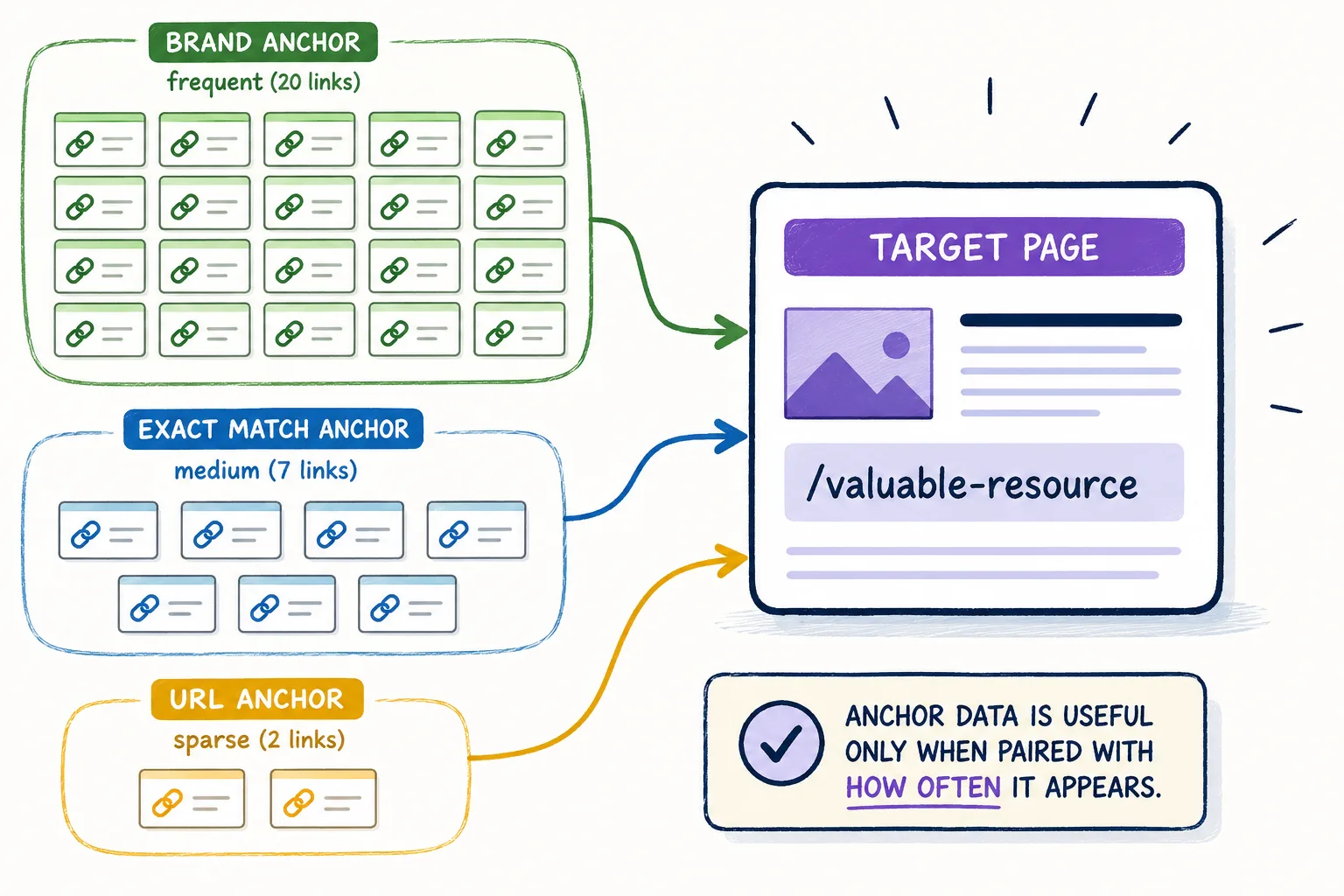
Worse, 12 of the 18 use the identical phrase, and 9 of those went live within a seven-week window two years ago.
The instinct is to remove links. That is wrong on three counts: you lose the equity, you frequently cannot get them removed, and preemptive disavowing has damaged more profiles than it has rescued.
The fix is dilution. Add 25 new links skewed toward branded, naked URL, and partial match. The distribution becomes 18 of 65, or 28%. Same exact-match links, materially different shape, nothing lost.
Add another 20 over the following quarter and it falls under 22%.
The rule: if exact match on a commercial page is climbing past roughly a quarter of inbound anchors, stop requesting it and build variety until the ratio comes back. More varied links, not fewer links.
That has an operational consequence worth planning for — dilution requires acquisition capacity, which means it works only if you have a tactic that produces links reliably. The anchor text distribution guide covers where that capacity fits alongside the other portfolio controls.
Controlling anchors where you have a say
When you choose the anchor — exchanges, placements, arranged links — propose it rather than leaving it open, and vary it across placements. Requesting the same phrase repeatedly is the failure mode and it is entirely self-inflicted.
When you do not choose — editorial links — this is fine and it is the point. Naturally chosen anchors are exactly the variety you are trying to manufacture elsewhere.
Do not demand exact match in exchange criteria. Beyond the profile risk, it narrows your partner pool sharply. Experienced publishers know what a page full of exact-match outbound anchors does to their own site and will decline.
Internal links are a different regime. There is no over-optimisation risk from your own internal anchors of the kind that applies externally, so descriptive internal anchors are simply good practice. That asymmetry surprises people.
The over-correction, which is also a pattern
Someone reads this, panics, and swings to branded anchors on every built link. Forty links to one page, all reading with the company name.
That is also uniform. It is a safer uniformity, but a page with forty inbound links and one anchor phrase is a page whose links were arranged, whatever phrase was chosen. The signal is the concentration, not the keyword.
The same applies to perfectly engineered ratios. A profile hitting an exact target split across five categories, month after month, describes a spreadsheet rather than a set of publishers making independent choices. Real distributions are lumpy — some months skew branded, some produce two partial matches and nothing else, occasionally someone links with a phrase you would never have picked.
The goal is variety that looks unplanned, which means accepting untidiness rather than optimising toward a target. If your anchor report looks designed, it was.

Four cases where the standard advice does not apply
Your brand name is your keyword. If the company is called Project Management Software, branded and exact-match anchors are identical and the distribution question largely dissolves. This is a genuine and underrated advantage of exact-match brand names, and it means the ratios in this article do not apply to you in the same way.
You inherited the profile. A site acquired with heavy exact-match anchoring is not a decision you made and not one you can undo. Dilution is the only route, and the timeline is longer because you are diluting a larger existing base.
Non-English and multilingual profiles. Anchors in other languages pointing at the same page are variety rather than duplication, and usually a healthy sign. Do not categorise them against your English target phrases.
Very high authority pages. A page with 400 organic referring domains absorbs anchor concentration that would be alarming on a page with 30. The ratios that matter are proportional, and on pages like this the built links are a rounding error. Spend your audit time on the pages where they are not.
At portfolio scale
Running this across multiple sites or client accounts adds a failure mode that does not exist on a single site.
Anchor patterns can converge across properties. If the same person is setting anchors for six sites, those six profiles start to resemble each other — similar category splits, similar phrasing habits, similar variants. That is a cross-property footprint, it is invisible from inside any single account, and it belongs with the other portfolio controls in the link exchange footprint guide.
Three controls:
- Set different thresholds per property rather than applying one house standard everywhere
- Vary the phrasing conventions. If every site you manage uses the same partial-match construction, that is a signature
- Audit the overlap. Compare anchor distributions across your properties quarterly, looking for resemblance rather than for individual problems
What to track
Per commercial target page, quarterly:
- Category shares across the six types
- Top five individual phrases by frequency
- Exact-match share, and its direction over the last two quarters
- First-seen date distribution on exact-match links
- Whether new links are moving the ratio toward or away from where you want it
Direction matters more than the absolute number. A page at 30% exact match and falling is in better shape than one at 22% and climbing, because the second describes an ongoing process and the first describes a corrected one.
Direction is the number to report and the one most people never calculate.