

The disavow tool has damaged more link profiles than it has rescued. Google has said for years that it ignores most low-quality links automatically, which leaves a much narrower set of situations where disavowing is the right call than most SEOs assume.
Someone runs a backlink audit, sees eighty links from sites they do not recognise, and reaches for the disavow file. It feels like hygiene.
It is closer to surgery, and it is frequently performed on a patient who was not ill.
What the tool actually does
The disavow tool tells Google to ignore specified links when assessing your site. You upload a text file listing individual URLs or entire domains, and Google treats those links as though they do not exist for ranking purposes.
Two properties matter and both are frequently missed.
It is not a removal request. The links remain live. Other search engines still count them. You have changed how one system evaluates them, nothing more.
It is not reversible on a useful timescale. Removing entries from the file and resubmitting requires recrawling every affected link before the value returns, if it returns. This is not an undo button.
Why most disavowing is unnecessary
Google’s public position for many years has been that its systems ignore the overwhelming majority of low-quality links automatically. Spam links are treated as noise rather than as votes against you, which means the negative outcome most people are disavowing to prevent is largely already handled.
That position is not universally accepted, and there is some counter-evidence — internal documentation surfaced in 2024 referenced a signal relating to bad backlinks, which suggests heavily contaminated profiles may contribute negatively rather than being purely discarded. Treat that as unresolved rather than settled.
But the practical asymmetry holds regardless:
The cost of unnecessary disavowing is certain. Every legitimate link caught in the file stops passing value. On a broad domain-level disavow, that is frequently a substantial share of what you had.
The benefit of unnecessary disavowing is speculative. You are removing links that were probably already being ignored.
Certain cost against uncertain benefit is a bad trade, and it is the trade most disavow files represent. The risks that genuinely warrant attention are patterns rather than individual links, which the link exchange footprint guide covers in detail.
When it is genuinely warranted
Three situations. Not four, not a general audit finding.
1. A manual action for unnatural links. This appears in Search Console under Manual Actions. It is unambiguous — a human reviewer has assessed your profile and applied a penalty. Disavow is part of the standard remediation alongside removal attempts and a reconsideration request.
2. You know manipulation occurred. You bought links, or a predecessor did, or an agency you no longer use built a network on your behalf. You are not guessing from a toxicity score — you have specific knowledge of what was built and why.
This is the case for disavowing preemptively, and the argument for it is not primarily algorithmic. It is that a manual review at some future point would find something indefensible, and you would rather it did not.
3. Genuine negative SEO with evidence. A sudden influx of thousands of links from an obviously coordinated source, appearing in a short window, with no plausible legitimate origin. Rare, frequently misdiagnosed, and worth a second opinion before acting.
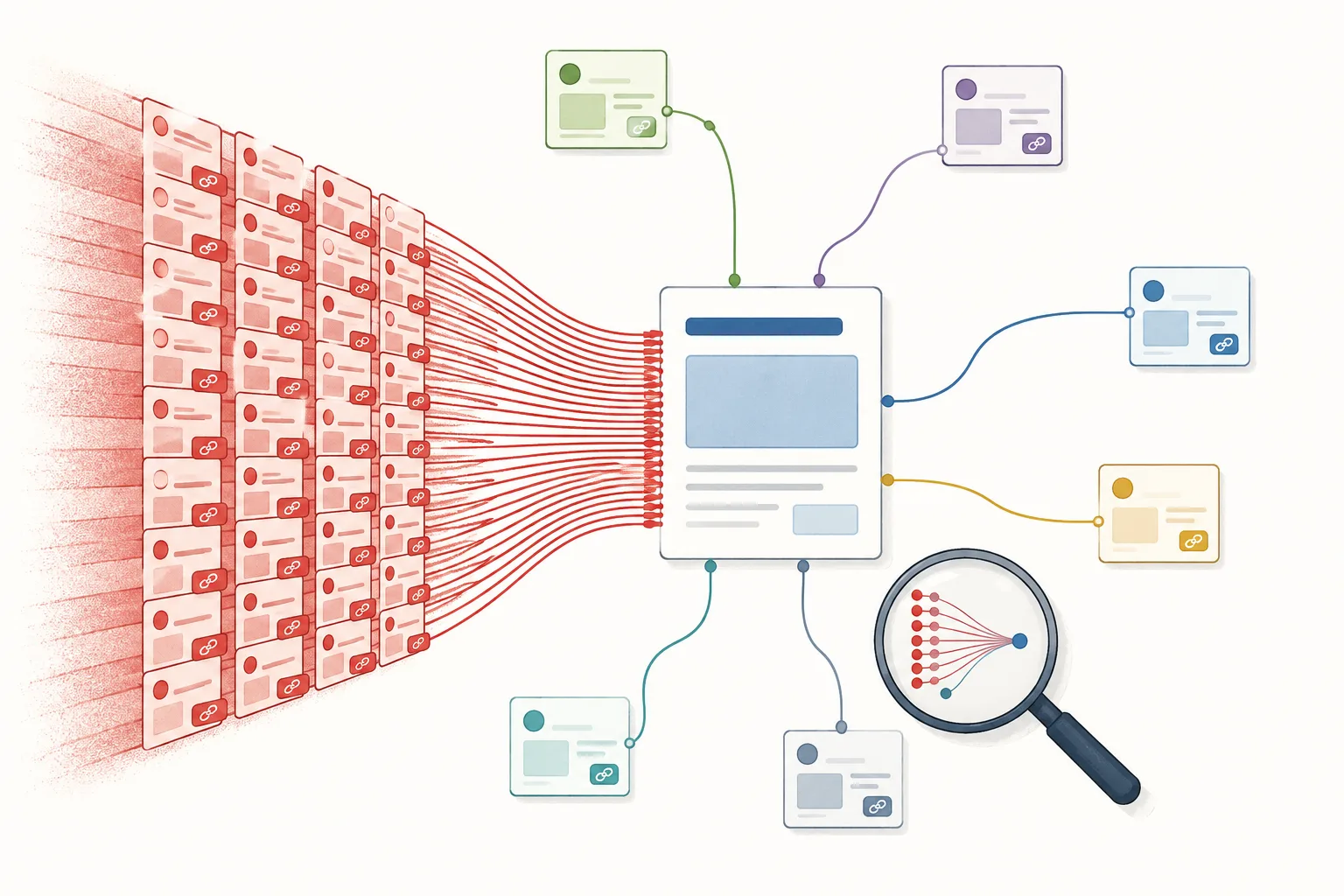
When it is not warranted, despite feeling like it should be
A toxicity score flagged links. Third-party toxicity metrics are proprietary heuristics, not Google signals. They are frequently wrong in both directions, and treating a vendor’s score as authority for a permanent action is an error of category.
You do not recognise the linking sites. Most sites have inbound links they cannot account for — scrapers, aggregators, directories, foreign-language sites, forum quotes. Unfamiliarity is not evidence of harm.
Rankings dropped and you are looking for a cause. This is the most common and the most damaging. Ranking drops have many causes, and the disavow file is a slow-acting, hard-to-reverse intervention applied on a hunch. Diagnose first.
An audit turned up spam. Every profile contains some. It is noise.
You are preparing a site for sale or acquisition. Instinct says clean it up. A disavow file transfers with the domain and the buyer inherits a decision they did not make and cannot easily evaluate. Disclose the profile instead.
If you have decided to do it
Assuming one of the three warranted cases genuinely applies.
- Attempt removal first. For a manual action this matters — Google’s guidance expects demonstrated effort. Contact site owners, log every attempt with dates, and keep the record for the reconsideration request. For preemptive disavowing on links you commissioned, removal is often faster than it sounds because you know who to contact
- Export your full referring domain list. Search Console’s Links report plus a backlink tool. Work from a complete picture, not a filtered one
- Categorise by hand. Every domain, individually assessed. This is slow and there is no substitute — you are making permanent decisions and a tool’s score is not a reason
- Prefer domain-level entries for genuine spam networks, URL-level for isolated cases. The
domain:prefix covers every URL on a domain - Format correctly. Plain text, one entry per line,
domain:example.comfor whole domains, full URLs otherwise. Comments start with# - Keep the file cumulative. Each upload replaces the previous entirely. Uploading a new file without the old entries un-disavows everything in it
- Document your reasoning in comments. In eighteen months nobody will remember why a domain was included, including you
- Submit and wait. Effects require recrawling every listed link, which takes weeks to months
Negative SEO, and why it is usually misdiagnosed
Worth addressing directly, because fear of it drives a large share of unnecessary disavowing.
Negative SEO — someone deliberately building spam links at your site to harm it — is real but considerably rarer than the industry’s anxiety about it suggests. Google’s stated position is that its systems ignore obvious spam, which is also what makes the attack unattractive: an attacker is spending money on links that are unlikely to do anything.
What gets mistaken for it:
Scraper and aggregator links. Sites that republish content automatically will link to you at volume without any human involvement. This looks alarming in a report and is background noise on the modern web.
Expired domain rebuilds. A site that once linked to you legitimately gets sold and repurposed. The link persists on a site that now looks nothing like the one that placed it.

Your own historic activity. Links built years ago by someone else at the company, or an agency nobody remembers hiring, resurfacing in an audit as mysterious spam.
Competitor coincidence. Two sites in the same niche picking up links from the same low-quality directory network is not an attack. It is a directory network.
What genuine negative SEO looks like: thousands of links appearing in a compressed window, from an obviously coordinated source, frequently with aggressive commercial anchor text pointing at one page, with no plausible legitimate origin. The pattern is unmistakable when it is real, which is a useful diagnostic in itself — if you are uncertain whether you are under attack, you probably are not.
At portfolio scale
Agencies inherit disavow files, and this is where the real damage tends to be.
Audit inherited files before assuming they are correct. A file built by a previous agency in a panic three years ago may be suppressing perfectly good links. Read it. If entries are unexplained and the situation that produced them is unclear, that is worth investigating before continuing to carry it.
Never apply a house disavow policy. Disavowing is per-account and evidence-based. A standard process that produces a file for every client is producing files for clients who do not need one.
Record the decision. Who decided, when, on what evidence. This is the kind of action that gets questioned years later by someone who was not there — and it belongs in the same audit record as the partner vetting and overlap checks in the advanced link exchange strategy guide.
Do not disavow to demonstrate diligence. A visible artefact showing the account is being managed is not a reason to take a permanent action. If a client wants evidence of link hygiene, show them the audit and the partner vetting record instead.
What to do instead, in almost every case
The productive response to a profile that concerns you is nearly always dilution rather than removal.
Build relevant links from real sites. Grow the denominator. A profile with 40 questionable links out of 60 is a problem; the same 40 out of 300 is a rounding error, and you got there without a single permanent decision.
This is the same principle that applies to anchor concentration, where the fix for a skewed ratio is more varied links rather than fewer links. It works for the same reason: you are changing the shape of the profile without destroying anything you cannot recover.
The other productive response is fixing what you control. Your own outbound profile, your placement standards, your partner vetting, your pacing. Those determine what your profile looks like going forward, which is the part you can actually influence.
The short version
Disavow if you have a manual action, if you know manipulation occurred, or if you have evidence of a genuine attack.
Otherwise, do not. The links you are worried about are probably already being ignored, the file is difficult to reverse, and the most likely outcome of an enthusiastic disavow is that you removed value you had earned.
When in doubt, dilute.