

Running link building for one site is a tactic. Running it for five is a pattern problem: the same person, the same tools and the same partners produce profiles that resemble each other. No single-site audit can see that. Here are the four cross-property signals and the controls that stop them forming.
Most link building advice assumes one site. You pick partners, set anchors, pace placements and audit the result. Every check happens inside one profile.
Add a second site and nothing about those checks changes. Add a fifth and they stop being enough. Each profile can pass its own audit while the set of them forms a shape nobody would produce by accident.
This applies whether the sites are your own portfolio, a group of brands under one company, or client accounts at an agency. The mechanics are identical. Only the paperwork differs.
Why one site’s audit cannot see the problem
A single-site audit asks whether this profile looks natural: relevant partners, varied anchors, a curve with a plausible cause. Those are the right questions, and the advanced link exchange strategy guide covers them in full.
The cross-property question is different: do these profiles look like they were built independently? Five sites run by five unrelated owners would differ in partners, timing, anchor habits and structure, because five people make different choices.
One operator does not. Habits repeat. Partner lists get reused because they worked last time. Campaigns launch on the same Monday because that is when the work gets done. The result is convergence, and it is only visible from above, which is exactly where a link graph looks from.
The four cross-property signals
- Shared partners. The same referring domains appear across several of your sites. Two sites sharing a partner is unremarkable. Six sites drawing from one pool of thirty partners means you have built one link profile six times, and a problem with one property becomes a problem with all of them.
- Synchronised curves. Acquisition rises and falls across your sites in the same weeks. Unrelated sites do not accelerate in the same fortnight. If your team works in monthly cycles, every property inherits that rhythm.
- Converging anchor conventions. One person setting anchors develops a style: the same partial-match construction, the same branded variants, the same ratio. Read fifteen anchors from each site side by side and the shared author shows. The per-page rules are in how to fix an over-optimised anchor text profile. Across sites, the issue is resemblance rather than ratio.
- Links between your own properties. Your sites linking to each other, directly or through partners who link to all of them. Occasional, genuinely relevant references between sister sites are normal. A web where every property links to every other, in body content, with commercial anchors, is a private network with extra steps.

These compound. Shared partners plus synchronised timing is far louder than either alone, because each makes the other easier to read.
Partner allocation, the core control
Treat your partner pool as a resource to divide, not a list to share.
- Assign each partner to one site by default. Overlap should be the exception, with a reason you could state out loud, such as a partner that genuinely fits two niches
- Set an overlap cap and write it down. A working ceiling is that no two of your sites share more than about one in ten referring domains. There is no official number. The point is to pick one and enforce it in your process rather than in your intentions
- Vary the pool composition. Different DR bands, different adjacent niches, different geographies where relevant. Two of your sites should not have profiles that look like siblings
- Keep an overlap matrix. Partners down one side, sites across the top, updated when a placement goes live. By hand this becomes unmanageable around the fourth site, which is where tooling stops being a convenience
The matrix is also your early warning. If a partner degrades, starts selling placements or sees its outbound count jump, you know at once which of your sites are exposed.
Per-site standards rather than house standards
Operators running several sites naturally build one standard: one DR floor, one anchor split, one monthly target. Consistency is how a small team delivers reliably.
That consistency is the footprint. A single standard applied everywhere produces the convergence above, and it is wrong for most of the sites anyway.
Set thresholds per site. A DR 30 floor is aggressive for a DR 15 site and conservative for a DR 55 one. The monthly rate should scale with each site’s own referring domain base, using the proportional method in how many backlinks per month should you build.
Vary anchor conventions on purpose. Give each site its own branded variants and its own way of phrasing partial matches. Different sites should read as though different people built them.
Offset the calendars. Stagger campaign start dates across properties by a week or two. If one site launches a batch this week, the next one waits. Running several campaigns on a single site is its own scheduling problem, covered in how to run multiple link campaigns at once.
Linking your own sites to each other
The tempting shortcut: you already own five relevant sites, so link them to each other. It feels free, and it is the most legible pattern available.
Google’s spam policies name excessive link exchanges and partner pages built purely for cross-linking. A set of sites under one owner, all linking to each other in body content, is that pattern without even the cover of different owners.
What stays defensible:
- A link where a reader genuinely needs it. Your hosting brand referencing a migration guide on a sister site, once, in context
- Navigation that says what it is. A footer line naming your group’s other brands is an ownership disclosure, not a ranking tactic
- Nothing routed through partners. If a marketplace or partner places links from your site A to your site B, you have built a private network with a paper trail
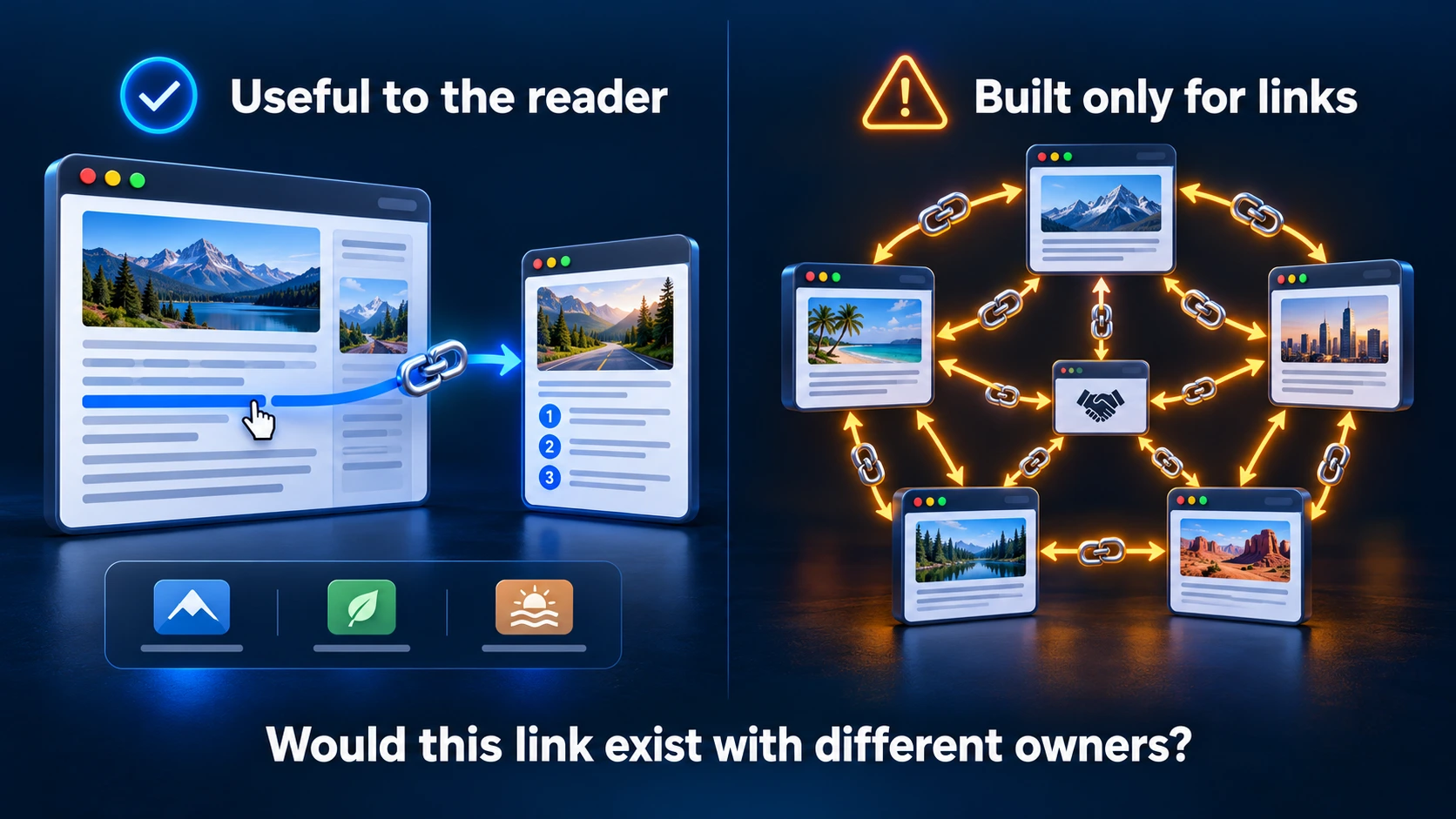
The test: would the link exist if the two sites had different owners? If not, leave it out.
Worked example: five sites, one operator
An operator runs five sites in adjacent niches: project management, remote work, SaaS operations, hiring and productivity. Referring domains range from 40 to 310. One person handles link building for all five.
What the first cross-property audit found:
- Overlap. 22 partners appeared on three or more sites. The productivity and remote work sites shared 31% of their referring domains
- Timing. All five sites showed acquisition spikes in the first two weeks of each month, matching the operator’s work cycle
- Anchors. Four of the five used the same partial-match construction, “guide to [topic] for teams”, across most built links
- Cross-links. Each site linked to at least two of the others from body content, with commercial anchors
No single site’s audit flagged anything. Each profile looked reasonable alone.
What changed:
- Partners reassigned so each one primarily served one site. Overlap between any two sites capped at 10%, reached over two quarters by routing new placements away from shared partners rather than removing anything
- Campaign starts staggered one site per week, on a five-week rotation
- A separate anchor convention written down for each site
- Body-content links between the sites cut to three, each one a reference a reader would genuinely follow
None of this reduced link volume. It changed the shape of five profiles so they no longer looked like one.
The quarterly cross-property audit
Per-site audits stay as they are; the checklist in how to check if your link building is working covers them. Add this on top, once a quarter, across every site you run:
- Overlap matrix. Shared referring domains between each pair of sites, as a percentage of the smaller site’s profile. Anything over your cap gets new placements routed elsewhere
- Curve comparison. Plot every site’s monthly new referring domains on one chart. Lines rising and falling together is the signal
- Anchor comparison. Fifteen anchors from each site, read side by side. Shared phrasing habits show immediately
- Cross-link check. List every link between your own properties. Each one should pass the different-owners test
- Partner drift. Partners that have degraded since placement, flagged across every site they appear on at once
Have someone other than the person who built the profiles run it. Whoever made the choices is the worst placed to notice what they have in common.
Where the plugin fits
Most of the controls above are bookkeeping: which partner is placed where, when each campaign runs, which links are still live. That is the part that breaks first at portfolio scale.
Linkexchange runs the exchange cycle from inside each site’s WordPress dashboard. You set the criteria per site, target page, niche and minimum DR, and qualifying publishers take the offer. Because any qualifying publisher can take an offer, the links are not mutual pairs by default. Settlement runs on credits, referral traffic is attributed per link, and placements are monitored, so a removed link surfaces when it happens.
What it does not do is set your thresholds or allocate your partners. Overlap caps, per-site standards and calendar offsets are decisions. A tool executing one house standard across five sites efficiently makes the pattern clearer, not weaker.
The internal linking tools are included free on each site: orphan pages, weak pages, authority flow, broken internal links and cluster analysis. Internal links carry none of the cross-property risk above, which makes them the safest place to put effort first.
The short version
Five sites built by one operator drift toward one profile. The four signals are shared partners, synchronised curves, converging anchors and links between your own sites. Each is invisible from inside a single account.
Divide the partner pool and cap overlap. Set standards per site, not per operator. Offset the calendars. Keep links between your own properties to what a reader genuinely needs. Then audit across the sites, not just within them, once a quarter.