

You posted a request and nothing happened. That is almost always one of five things, and four of them are settings you can change this afternoon. Here is how to diagnose which, in the order worth checking.
On a marketplace you do not write a link exchange request. You post one — target page, niche, minimum DR — and publishers who fit those criteria take it. Which means the failure mode is different from outreach. Nobody rejected you, because nobody was asked. Your request either did not reach enough qualifying publishers, or it reached them and they looked at what you were offering and moved on. Those need different fixes, and telling them apart takes about ten minutes.
What a request actually is
Four things, and every one of them is a lever.
Your target page. The URL you want linked. This is the thing publishers actually evaluate.
Your niche and adjacency band. Which industries you will accept a link from. This decides the size of the pool.
Your quality floor. Minimum DR, minimum traffic. This decides how much of that pool qualifies.
What you are offering back. A placement on your site, and how appealing that is depends on your own DR, traffic, and the pages available. A request that gets no takers has a problem in one of those four. Usually the second or third, occasionally the first, and sometimes the fourth in a way no setting will fix.
The five reasons nobody is taking it
In order of how often they are the actual cause.
1. Your criteria are too narrow. The most common by a distance. An exact-niche requirement plus a high DR floor produces a pool of almost nobody, and the queue stays empty.
The fix, and the order matters: widen the adjacency band before you lower the DR floor. A relevant DR 35 partner outperforms an unrelated DR 50 one, and relevance is the cheaper variable to give ground on — the market barely prices it, which makes it the one you can afford to be generous with. Adjacent is usually better than exact anyway. Your closest competitors are the sites least likely to trade with you.
2. Your target page is thin. Publishers look at what they are being asked to link to. A four-paragraph service page with a contact form does not get taken, whatever the terms, because linking to it makes their article worse.
The fix: point the request at your strongest relevant page instead, or improve the page before re-posting. If you would not link to it from your own site, nobody else will either. This is the one people resist, because the thin page is usually the commercial page they most want ranked. The workaround: get the link to a strong nearby page and route the authority internally from there.
3. The DR gap is unrealistic. Sites more than roughly ten to fifteen points above you have little reason to trade. The value moves one way and they know it. Setting your floor there means qualifying publishers exist and none of them are interested.
The fix: set the floor near your own DR. That band is where the pool is largest and where the trade is genuinely mutual.
4. You have nothing appealing to offer. The fix that is not a setting. If your site has low DR, little traffic, and no relevant pages to place from, adjusting criteria will not help — the problem is on your side of the trade.
The fix: internal linking and the links you already have. Route authority to your commercial pages, claim the relationship links you have never asked for, and recover the ones you lost. That work costs nothing, needs nobody’s cooperation, and it makes you a partner worth trading with — which is the actual bottleneck. The how to get backlinks guide ranks those tactics alongside the ones that need a partner at all.
5. Your anchor demands are too specific. Insisting on an exact-match commercial anchor narrows the pool sharply. Experienced publishers know what a page full of exact-match outbound anchors does to their own profile, and they decline.
The fix: propose branded or descriptive anchors, or leave it open. You want variety across your profile anyway, so this costs you nothing you should have wanted.
Ten minutes to work out which
- Count qualifying publishers. If the pool at your current criteria is tiny, it is reason one. Widen adjacency and look again
- Open your target page and read it as a stranger. Would you link to this from an article of your own? If not, reason two
- Compare your DR to your floor. More than fifteen points above your own, reason three
- Look at what you are offering. Do you have a relevant page with real traffic that a link would sit naturally inside? If not, reason four
- Check your anchor setting. Anything exact-match and commercial, reason five
Most requests that go untaken fail on one and two together — narrow criteria pointing at a page that would not have been taken anyway.
What a request that gets taken looks like
Concretely, for a DR 32 project management blog:
- Target page — a substantial guide with existing traffic, not the pricing page
- Niche — project management, plus productivity, remote work, and SaaS operations as adjacent
- DR floor — 25, not 50
- Minimum traffic — set, because DR without an audience is half an asset
- Anchor — descriptive or branded, left flexible
- Offering — a named page on their side with genuine relevance, in body content, do-follow
The pattern: generous on niche, realistic on DR, strict on what you place and where.
After it is taken
Getting the placement is the easy part. What decides whether the link does anything:
Relevance to your niche or an adjacent one.
Placement inside genuine content rather than a resources block.
A moderate pace rather than a burst — several placements going live in the same fortnight is a pattern regardless of how good each one is. And partner quality:
real traffic, real content, a clean outbound profile. Those four are the conditions that decide whether exchange works at all, covered in does link exchange actually work. Then monitoring, because a meaningful share of what you place will be gone within a year and you will not know which without checking. A link that came down is worth exactly what a link you never got is worth.
Where the plugin fits
Linkexchange is the marketplace this describes, running inside your WordPress dashboard. You post the request, qualifying publishers take it, settlement runs on credits, referral traffic is attributed per link so you can see which partners send real people, and placements are monitored so removals surface immediately. Because any qualifying publisher can take an offer, the resulting links are not mutual pairs by default — the symmetrical A-links-to-B pattern that makes bilateral swapping obvious at volume does not form. The internal linking tools are included free, and reason four above is exactly what they address. Analysis costs nothing — orphan pages, weak pages, authority flow, and the connections your site is missing. Acting on a couple of hundred opportunities by hand is an afternoon; bulk apply does it in one click on the paid tier. On a site with nothing appealing to trade yet, that is the work that changes it.
The manual version, for the occasional one-off
You will sometimes want a link from one specific site that is not in any marketplace. That is an email, and it is a different job. Six things it should contain, and nothing else:
- Who you are — one sentence
- The specific page of theirs you would link from, and where in it
- The specific page of yours, and why it helps their readers rather than you
- Proposed anchor text, branded or descriptive
- Confirmation it is do-follow and in body content — stating this unprompted signals you know the difference
- A clean exit — one line making it easy to decline
Subject: Link swap — [their topic] / [your topic] Hi [name], I run [site], which covers [topic]. I was reading your piece on [specific article] and there is a natural spot in the [specific section] where a reference to [your page] would give readers the detail you skipped past. In return I would link to [their specific page] from [your specific page], in body content, do-follow, with the anchor text “[proposed anchor]”. Both links sit inside real articles — no partner pages, nothing in a footer. If it is not a fit, no problem at all. [name]
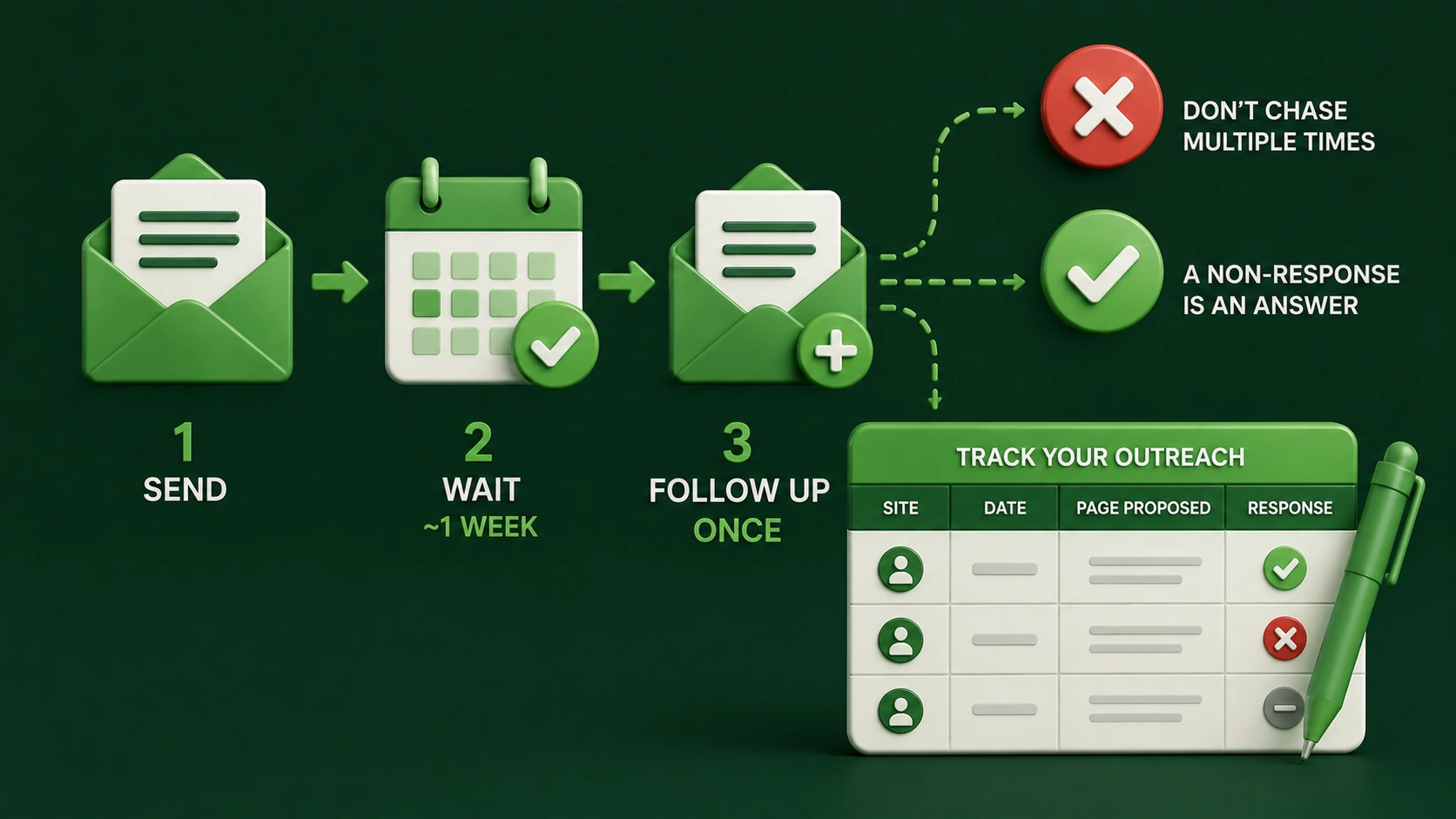
One follow-up after a week, adding something rather than repeating. Then stop — a non-response is an answer, and the industry is small enough that chasing costs you future placements.
The short version
An unaccepted request is a settings problem four times out of five, and the settings are yours. Widen adjacency before lowering DR. Point at a page worth linking to. Set the floor near your own level. Leave the anchor flexible. And if none of those apply, the constraint is what you have to offer — which is a different problem, and one you can fix without anyone else’s cooperation. And if the answer turns out to be that exchange is not the right tactic for your site yet, that is useful to know early rather than after three months of an empty queue.